


 (written
  in the
figure) with the total absolute magnitude
in the
figure) with the total absolute magnitude
 +constant, for
a sample of spiral galaxies. Brighter spirals (more negative
+constant, for
a sample of spiral galaxies. Brighter spirals (more negative  )
rotate faster (larger ). Since the figure shows there to be a
linear relation between and , it implies a power-law relation
between the intrinsic luminosity
)
rotate faster (larger ). Since the figure shows there to be a
linear relation between and , it implies a power-law relation
between the intrinsic luminosity  and the circular velocity ,
called the Tully-Fisher relation:
and the circular velocity ,
called the Tully-Fisher relation:
The slope  of this relation depends somewhat on which colour is
used (i.e., does refer to a V -band or I -band luminosity).
of this relation depends somewhat on which colour is
used (i.e., does refer to a V -band or I -band luminosity).
 |
What is the origin of this relation? Remember10.1that the circular velocity is determined by the enclosed mass
 ,
,
 |
(10.2) |
Let us introduce a global mass-to-light ratio, [M/L], as
![$\displaystyle \hbox{[M/L]}\equiv {M(<R)\over L}\,,$](img641.png) |
(10.3) |
then
![$\displaystyle V_c^2\propto \hbox{[M/L]}\, {L\over R}\,.$](img642.png) |
(10.4) |
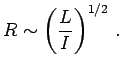
The mass-to-light ratio [M/L] will depend on the type of stars in the
galaxy (which determines ), and the amount of dark matter (which
mainly determines ). The intensity  is the luminosity per unit
area,
is the luminosity per unit
area,
 , or solving for
 |
(10.5) |
Combining the last two equations gives
![$\displaystyle L\propto {V_c^4\over\hbox{[M/L]}^2\,I}\,.$](img645.png) |
(10.6) |
So the Tully-Fisher relation is reproduced, with  , if the
intensity and mass-to-light ratio [M/L] are independent of
the luminosity of the galaxy. Notice that this is not a derivation of the Tully-Fisher relation: we are just trying to
understand what is required for spirals to follow this relation. The
fact that [M/L] and are independent of implies that somehow
stars and dark matter are closely linked, or in other words: the star
formation history is largely determined by the mass of the dark halo of
the galaxy.
, if the
intensity and mass-to-light ratio [M/L] are independent of
the luminosity of the galaxy. Notice that this is not a derivation of the Tully-Fisher relation: we are just trying to
understand what is required for spirals to follow this relation. The
fact that [M/L] and are independent of implies that somehow
stars and dark matter are closely linked, or in other words: the star
formation history is largely determined by the mass of the dark halo of
the galaxy.

 (in km s
 ). Brighter
spiral galaxies (more negative
). Brighter
spiral galaxies (more negative