


 |
 |
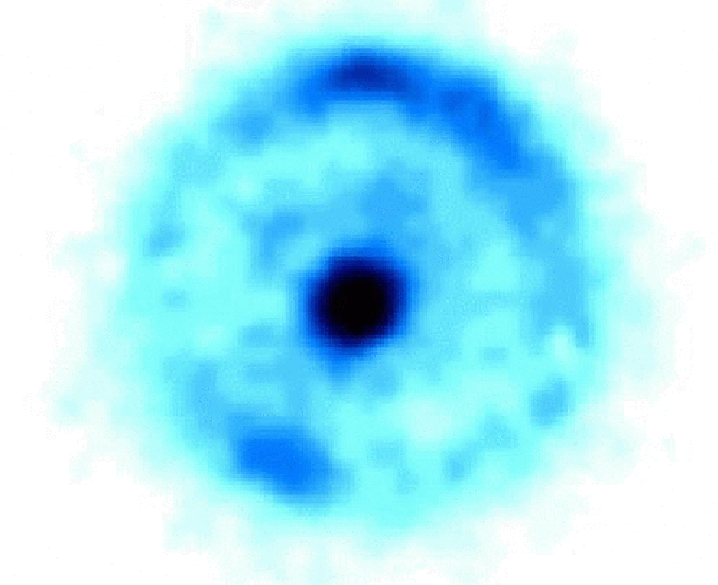
Suppose the light source (S), lensing mass  (L) and observer (O) are
exactly aligned, as in Fig.12.1. Also assume they are all
point like (i.e. not extended like for example a galaxy). Light rays
from S are deflected by L over an angle
(L) and observer (O) are
exactly aligned, as in Fig.12.1. Also assume they are all
point like (i.e. not extended like for example a galaxy). Light rays
from S are deflected by L over an angle  toward O. Because of
symmetry of the situation, O sees a ring of light around L: an Einstein
ring. Of course the figure is not to scale: should be small if
we want to apply the lensing equation.
toward O. Because of
symmetry of the situation, O sees a ring of light around L: an Einstein
ring. Of course the figure is not to scale: should be small if
we want to apply the lensing equation.
Introducing the distances between observer and lens  , observer
and source
, observer
and source  , and lens and source
  , we can compute
  and the angle
 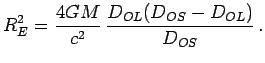 under which O sees the ring. Since
 we get, using the lensing equation and the figure,
 |
 |
 |
|
 |
|
 |
|
 |
|
 |
(12.4) |
and hence
 |
(12.5) |
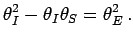
If O, L and S are not aligned, as in Fig.12.2, then O does not
see a ring. Denote the angular position of S from the line OL by
 , and the angle between S and its image I by
  . Then
from the figure you see that
. Then
from the figure you see that
 . A bit of juggling
and using the lensing equation gets you to:
. A bit of juggling
and using the lensing equation gets you to:
 |
(12.6) |
This is a quadratic equation for for a given and
so there will be two images, at positions
 .
.
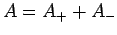
Often, the change in position will be very small and not
observable. But besides being lensed, an image will also be magnified (or de-magnified). So when the displacement is too small to
see two images, you'll only see one but magnified by total
magnification of each image separately. Interestingly, for
a small fraction of peculiar alignments,  may diverge, and so
potentially you can get very large amplifications.
may diverge, and so
potentially you can get very large amplifications.