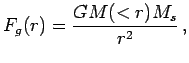
Let  be the mass inside the shell of radius
  (consisting of
stars, gas and dark matter:
(consisting of
stars, gas and dark matter:
 ), and
 its thickness The gravitational force on the shell is
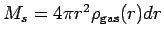 is the mass of the
shell.
is the mass of the
shell.
Let  be the pressure in the hot gas. The pressure force on a
surface is times the surface area,
be the pressure in the hot gas. The pressure force on a
surface is times the surface area,  . The net outward
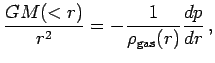
force is the difference between the outward and inward forces:
. The net outward
force is the difference between the outward and inward forces:
 |
(7.9) |

This should look familiar from hydrostatic equilibrium in stars!
By modelling the spectrum as function of position we can determine
 , and since the X-ray intensity
 , we can also determine
 . Hence
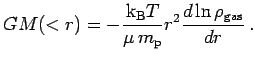
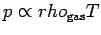 , and so we have determined the rhs of
Eq.(7.11). From that, one can reconstruct the gravitational
potential, and hence infer the mass distribution.
, and so we have determined the rhs of
Eq.(7.11). From that, one can reconstruct the gravitational
potential, and hence infer the mass distribution.
The temperature  is observed to remain approximately constant, in
which case we can obtain an approximate expression for the density
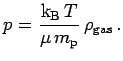
profile. The pressure is
is observed to remain approximately constant, in
which case we can obtain an approximate expression for the density
profile. The pressure is
 |
(7.12) |
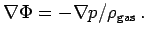
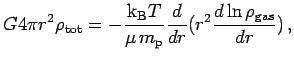
If we take constant then the rhs of Eq. (7.10) becomes
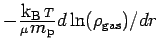 , and hence
Taking the derivative of both sides with respect to , gives
since
 .
.
 is the
total mass density, i.e. due to stars, gas and dark matter.
is the
total mass density, i.e. due to stars, gas and dark matter.
Now assume that the gas density and total mass density are
proportional,
 , and try a
solution of the form
, and try a
solution of the form
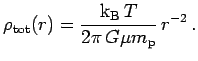
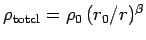 . Substitution shows that this is indeed a
solution when
. Substitution shows that this is indeed a
solution when  , in which case
 |
(7.15) |
So a measurement of can constrain the total mass density
. Estimating the stellar mass density from the
luminosity, the gas density from the X-ray emissivity, we find
 . More
detailed modelling of this type confirms that also elliptical galaxies
have most of their mass in the form of dark matter.
. More
detailed modelling of this type confirms that also elliptical galaxies
have most of their mass in the form of dark matter.