and velocity
  flies with impact
parameter
flies with impact
parameter  past an object with mass
  . The gravitational pull of
will deflect , and give it a component
. The gravitational pull of
will deflect , and give it a component  perpendicular
to its initial . For the case
perpendicular
to its initial . For the case  , this is in fact the situation
we envisaged when deriving the relaxation time in
Section 8.1. There we found that (see Eq. 8.3)
when the deflection angle
, this is in fact the situation
we envisaged when deriving the relaxation time in
Section 8.1. There we found that (see Eq. 8.3)
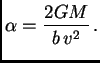
when the deflection angle  is small,
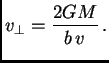 |
(12.1) |
Convince yourself that this is the correct result also in case  . Finally, since
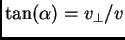 and when is small
so that
and when is small
so that
 ,
,
Now here's the trick: the expression for does not depend on
the mass of the particle being reflected, only on the mass of
the deflector. So we might be tempted to put  ,
,  and claim
this is the angle by which light will be deflected as well.
and claim
this is the angle by which light will be deflected as well.
Applying this to starlight passing close to the sun, hence using
 ,
,
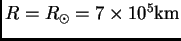 , we get
 -
so
-
so
 is certainly satisfied. This was actually the value
Einstein found in 1911, though one Johann Soldner already obtained it
almost a century earlier.
is certainly satisfied. This was actually the value
Einstein found in 1911, though one Johann Soldner already obtained it
almost a century earlier.
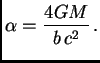
Curiously, the answer is wrong! Once Einstein formulated his theory of General Relativity, he did the problem again, and found that the deflection angle is twice our `Newtonian' value. So the correct deflection angle for light is
and it was of course a great vindication of the theory when Eddington
verified this during a solar eclipse in 1920. Note that the deflection
angle increases with and decreases with - the closer you pass
to the more massive an object, the bigger is the deflection.
In the case of the Sun, the deflection is so small that you might think it if of little use in Astronomy. This was actually true for a long time, but recently it has really taken off as a new way of looking at the Universe. Before I show you some applications, we need to do a little bit more maths first.