


 ,
,
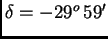 , at a distance of
  . The latter is called the
solar galacto-centric distance, and there is quite some discussion to
how large it really is.
. The latter is called the
solar galacto-centric distance, and there is quite some discussion to
how large it really is.
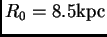 is usually quoted, but some
studies find
is usually quoted, but some
studies find
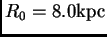 . These studies try to determine the centre
of a set of objects, for example globular clusters, variable stars such
as RR Lyrae or Mira variables, or O and B stars. An
. These studies try to determine the centre
of a set of objects, for example globular clusters, variable stars such
as RR Lyrae or Mira variables, or O and B stars. An  maser source
is located near the centre of the MW. The maser emission is thought to
come from a spherical shell, and one can measure both the radial and
transverse speed of the shell. If the shell is expanding spherically,
then one can determine its distance.
maser source
is located near the centre of the MW. The maser emission is thought to
come from a spherical shell, and one can measure both the radial and
transverse speed of the shell. If the shell is expanding spherically,
then one can determine its distance.
Apart from stars, the disk also contains gas and dust. On top of the
smooth disk are spiral arms, traced by young stars, molecular clouds,
and ionised gas. The disk stars are in (nearly) circular motion around
the centre. For the sun, the circular velocity is
 .
.
How old is the disk? We don't really know. But we can put limits on the
ages of the stars in the disk, but have to keep in mind that the
stars could possibly be older than the disk (i.e., they have formed
somewhere else). One neat age estimator are White Dwarfs. As you
recall, these don not undergo nuclear fusion anymore, but are presently
just cooling down. So, by measuring their current temperatures, and
cooling rates, we can compute how old they are. Some of the older White
Dwarfs are thought to be
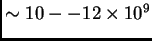 years old.
Let's describe the position of a star in the MW using cylindrical
coordinates
 , where
  is the distance to the centre,
 the distance to the plane, and
  an angle. The density of
stars in the disk goes approximately like
an angle. The density of
stars in the disk goes approximately like
 . Since the disk is (nearly) axis-symmetric,
 is independent of . Away from the centre,
  decreases exponentially, and at distance
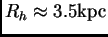 , it has
fallen to
, it has
fallen to  of it's central value. Also perpendicular to the disk,
the fall-off is exponential, with
of it's central value. Also perpendicular to the disk,
the fall-off is exponential, with
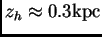 .
.  and
and  are called the scale length and scale height of the disk,
respectively. These scale lengths really depend on the type of star
you're using. Young stars are born out of gas, which is much more
concentrated toward
are called the scale length and scale height of the disk,
respectively. These scale lengths really depend on the type of star
you're using. Young stars are born out of gas, which is much more
concentrated toward  . And so the scale height of young stars is
much smaller than of older stars.
. And so the scale height of young stars is
much smaller than of older stars.
Note that there isn't really an edge to the disk. It can be traced to a distance of around 30kpc. With a height of 0.3kpc, this is a ratio 100:1, which is thinner than a compact disc!
Given the exponential distribution in , the luminosity profile (in
 per unit volume) of the disk is often modelled as
 is some normalisation constant. In the B-band, the total
luminosity is
is some normalisation constant. In the B-band, the total
luminosity is
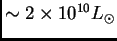 .
.
Because of the component I'll describe next, the disk is also sometimes called the thin disk.
