


Recall from the first part of the course that massive stars, like O and B-type stars, are hot and hence emit lots of hydrogen ionising photons. These photons have a dramatic effect on the surrounding gas, and convert the hydrogen into it's HII form. And so massive bright stars are often surrounded by HII regions. These regions delineate spiral arms, because star formation occurs predominantly in spiral arms and massive stars don not live for very long.
HII regions are important, not only because they are beautiful to look at4.2, but because their physics is reasonably well understood. And by observing the relative strengths of the emission lines that occur in their spectra, one can deduce the properties of the HII region, such as it's temperature, density, and the relative abundance of the elements.
There are two things I would like you to remember about this, one is to understand the physics that determines the properties of the spectrum that you get from such a nebula, and the second one to understand what sets their size (the so-called Strömgren radius
When an ion (for example HII, OIII, ...) recombines with an electron
(and form HI, respectively OII), the electron does not necessarily have
to fall directly to the lowest possible energy level, i.e. the ground
state. Taking the example of HI, the ground state would correspond to
the electronic  state. Typically, the electron will cascade down
to , and the relative probability for the intermediate steps can
be computed from quantum mechanics. However, this does not
translate directly into the spectrum you observe. For example, suppose
the electron makes a transition
state. Typically, the electron will cascade down
to , and the relative probability for the intermediate steps can
be computed from quantum mechanics. However, this does not
translate directly into the spectrum you observe. For example, suppose
the electron makes a transition
 , and emits the
corresponding photon. As this photon starts to move toward us, it may
actually interact with another neutral hydrogen atom, and cause the
electron of that atom to be excited from the to
, and emits the
corresponding photon. As this photon starts to move toward us, it may
actually interact with another neutral hydrogen atom, and cause the
electron of that atom to be excited from the to  level. In
which case the photon does not actually exit from the nebula! Suppose
on the other hand, the photon makes an
level. In
which case the photon does not actually exit from the nebula! Suppose
on the other hand, the photon makes an
 transition. This photon has much more chance of leaving the nebula,
since most of the neutral HI will be in the state, and not so
much in the state. And so that photon will escape from the
nebula. So curiously, it may be that lines with a low quantum
mechanical probability, dominate a nebular spectrum, since photons from
more likely transitions are unable to escape from the nebula. This is
especially true for Planetary Nebulae spectra.4.3
transition. This photon has much more chance of leaving the nebula,
since most of the neutral HI will be in the state, and not so
much in the state. And so that photon will escape from the
nebula. So curiously, it may be that lines with a low quantum
mechanical probability, dominate a nebular spectrum, since photons from
more likely transitions are unable to escape from the nebula. This is
especially true for Planetary Nebulae spectra.4.3
For an HII region, the dominant wavelength photon that escapes results
from the
transition, denoted as
H 4.4. This red line is the reason HII regions appear
to fluoresce red. And by observing galaxies through a filter that only
lets H light through, one can easily find HII regions.
4.4. This red line is the reason HII regions appear
to fluoresce red. And by observing galaxies through a filter that only
lets H light through, one can easily find HII regions.
Suppose a source of ionising photons such as a hot star starts emitting
ionising photons at a rate  , in photons per second, and
assume the source is surrounded by a homogeneous cloud of atomic
hydrogen, with density
, in photons per second, and
assume the source is surrounded by a homogeneous cloud of atomic
hydrogen, with density  . The source will quickly ionise all hydrogen
close to it. Let
. The source will quickly ionise all hydrogen
close to it. Let  be the radius of the ionisation front,
within which most of the hydrogen is ionised, and outside of which the
gas is mostly neutral. As
be the radius of the ionisation front,
within which most of the hydrogen is ionised, and outside of which the
gas is mostly neutral. As  increases between and
 , the
number
, the
number  of atoms that need to be ionised is
![$\displaystyle (4\pi/3)n[(R+\Delta R)^3-R^3]\approx 4\pi nR^2 \Delta R .$](img206.png) |
(4.1) |
Since it takes the source a time
 to produce this
many photons, we find that the speed of the front is
to produce this
many photons, we find that the speed of the front is
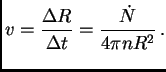 |
(4.2) |
Of course, this speed cannot be faster than the speed of light, and you
see that, as the HII regions grows in size, the speed with which it
grows decreases
 . However, eventually some of the HII
ions inside the ionisation front will start to recombine. Since extra
photons are needed to re-ionise these, the speed of the front will slowly
down even more. Eventually, an equilibrium is reached, in which the
number of photo-ionisations within equals the number of
recombinations. The radius of the HII region has grown to its maximal
size: the Strömgren radius,
. However, eventually some of the HII
ions inside the ionisation front will start to recombine. Since extra
photons are needed to re-ionise these, the speed of the front will slowly
down even more. Eventually, an equilibrium is reached, in which the
number of photo-ionisations within equals the number of
recombinations. The radius of the HII region has grown to its maximal
size: the Strömgren radius,  . To compute , consider a small
volume of the HII region. Since a recombination is an interaction between an
electron and an HII ion, the rate at which HII ions recombine is
proportional to the electron and the ion density:
. To compute , consider a small
volume of the HII region. Since a recombination is an interaction between an
electron and an HII ion, the rate at which HII ions recombine is
proportional to the electron and the ion density:
 |
(4.3) |
Since the recombination rate is in ions s volume, we find
that the recombination rate must have dimensions of volume
s. If the gas is composed purely of hydrogen, and is very highly
ionised, then
volume, we find
that the recombination rate must have dimensions of volume
s. If the gas is composed purely of hydrogen, and is very highly
ionised, then
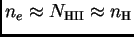 , where
  is the density of hydrogen, either HII or HI. The total number of
recombinations within radius is then
is the density of hydrogen, either HII or HI. The total number of
recombinations within radius is then
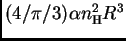 . In equilibrium, this is the rate
  at which the source
produces ionising photons. Equating these, we find that
at which the source
produces ionising photons. Equating these, we find that
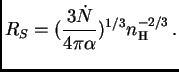 |
(4.4) |
For example, assume
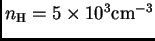 for the
density of the cloud, and
for the
density of the cloud, and
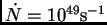 for the
ionisation rate of the star. Then
for the
ionisation rate of the star. Then
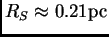 , since
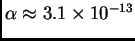 cm
cm s at a temperature
of
s at a temperature
of 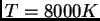 typical of HII regions.