


 . The biggest
problem with this, is how to determine
. The biggest
problem with this, is how to determine  , the distance to the cloud
that produces the absorption.
, the distance to the cloud
that produces the absorption.
A solution is to recognise from Eqs.(5.2) that  has a
maximum
has a
maximum
 |
(5.9) |
for any  with
with  , which occurs for
  , at which
point
, at which
point
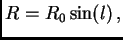 |
(5.10) |
is a minimum, and
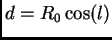 .5.3Combining these, we find
 |
(5.11) |
Performing this analysis essentially confirmed Oort's measurements,
i.e.  , the rate of change of the circular velocity with
  ,
is far smaller than you'd expect for a Keplerian rotation curve. In
fact, from measurements of Cepheids with
,
is far smaller than you'd expect for a Keplerian rotation curve. In
fact, from measurements of Cepheids with  it became apparent
that
it became apparent
that
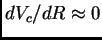 , i.e. the rotation curve is nearly flat, or
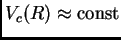 , as opposed to
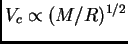 for
Keplerian fall-off - it is as if there is considerable mass outside
the solar circle.
for
Keplerian fall-off - it is as if there is considerable mass outside
the solar circle.