


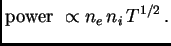
Let's try to obtain an expression for the radiated power. The aim of
this derivation is to show that the power emitted is
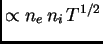 , where
  and
and  are the electron and ion
densities, and
are the electron and ion
densities, and  is the temperature. You could have guessed the first
bit, since we're talking about an encounter between two
particles. So the exercise is how to get the
is the temperature. You could have guessed the first
bit, since we're talking about an encounter between two
particles. So the exercise is how to get the
 dependence.
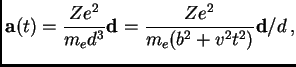
If the deflection angle is small, we can simple neglect it, and say
that the electron moves at constant speed  along a straight line
with impact parameter
along a straight line
with impact parameter  . The acceleration is then
 |
(6.1) |
where  is the charge of the ion in units of the electron charge
  ,
and
,
and
 is the distance between electron and ion.
  is the time
of closest approach, and so the encounter lasts from
is the time
of closest approach, and so the encounter lasts from
 to
to
 .
.
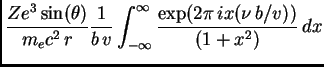
The dipole electric field at distance  from the electron is
 |
(6.2) |
This is the electric field as function of time  , but we want it as a
function of frequency
, but we want it as a
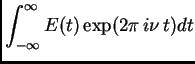
function of frequency  . The trick to obtain
  is by Fourier
transforming
is by Fourier
transforming  ,
,
 |
 |
 |
|
 |
 |
||
|
 |
||
|
 |
(6.3) |
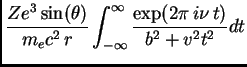
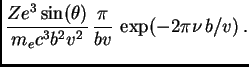
Along the way, I've introduced the variable  . The integral
 some function of
  is a
little tricky to perform, and I don't expect you to be able to do
it. What is important is to note that this change of variables gives
rise to a factor
is a
little tricky to perform, and I don't expect you to be able to do
it. What is important is to note that this change of variables gives
rise to a factor  .
.
Now we're done, because it means that the power radiated by this single electron per unit frequency is
 |
(6.4) |
So the spectrum is independent of for low frequencies
 , and cuts off exponentially for large . Now the number of
encounters with impact parameter between and
, and cuts off exponentially for large . Now the number of
encounters with impact parameter between and  , in time
  is
is
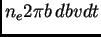 , and so this gives the power as
 |
(6.5) |
So the origin of the  is that the energy radiated per encounter
 whereas as the rate of encounters is
  .
.
To obtain the final result, we still need to integrate over the impact
parameter , and average over all impact velocities (for example
by assuming a Maxwell-Boltzmann distribution for ). The result is
that the total power emitted is
 |
(6.6) |
Notice that the total power is much more dependent on the density of
the gas ( density squared), than on its temperature
(
density squared), than on its temperature
(
 )
)