


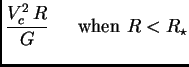
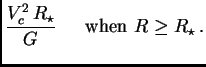
 out to some radius
  . Since
 , we have that
 |
 |
 |
|
|
 |
(7.2) |
Now the equation for the potential  is
is
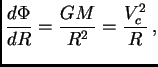 |
(7.3) |
for
 . Integration gives
 . We can determine the value of the
constant at
. We can determine the value of the
constant at  , since then
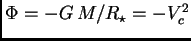 . Hence
![$\displaystyle \Phi(R) = -V_c^2\,\left[1+\ln(R_\star/R)\right]\,.$](img434.png) |
(7.4) |
Using Eq.(7.1) for the escape speed, we obtain
![$\displaystyle v_e^2 = 2\,V_c^2\left[1+\ln(R_\star/R)\right]\,.$](img435.png) |
(7.5) |
At the position of the Sun, we have
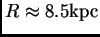 ,
,
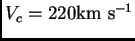 and
and
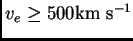 . This implies that
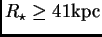 , and hence
Since the total luminosity of the MW is of order
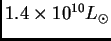 (in the V -band), it means7.4 that the mass-to-light ratio is at least
30. Given that the mass-to-light ratio of the MW stars is around
3 or so, it again suggest that a dominant fraction of the MW mass is
not in stars.
(in the V -band), it means7.4 that the mass-to-light ratio is at least
30. Given that the mass-to-light ratio of the MW stars is around
3 or so, it again suggest that a dominant fraction of the MW mass is
not in stars.
Another estimate of the MW mass comes from the motion of neighbouring galaxies in the Local Group.
