


 s to
s to  s of stars. Globular Clusters
(GCs) are spherical, gravitationally bound systems of
s of stars. Globular Clusters
(GCs) are spherical, gravitationally bound systems of  old
stars. Most galaxies contain 10s to 1000s of GCs, spherically
distributed around the parent galaxy. The MW has about 150 GCs. Stars
form in the MW disk out of large molecular clouds. Sometimes, after the
gas has been dispersed, the newly formed stars are gravitationally
bound to each other, in what is called an Open Cluster. These
typically contain of order
old
stars. Most galaxies contain 10s to 1000s of GCs, spherically
distributed around the parent galaxy. The MW has about 150 GCs. Stars
form in the MW disk out of large molecular clouds. Sometimes, after the
gas has been dispersed, the newly formed stars are gravitationally
bound to each other, in what is called an Open Cluster. These
typically contain of order  stars. So they differ from GC in that
they are typically smaller, have young stars, and lie in the galactic
plane. Star clusters are of great importance for studies of stellar
evolution, since we know all the stars in such a cluster have (more or
less) the same age, distance and initial composition, and hence they
provide us with a sample of stars in which the only (or at least the
main) difference is the stellar mass.
stars. So they differ from GC in that
they are typically smaller, have young stars, and lie in the galactic
plane. Star clusters are of great importance for studies of stellar
evolution, since we know all the stars in such a cluster have (more or
less) the same age, distance and initial composition, and hence they
provide us with a sample of stars in which the only (or at least the
main) difference is the stellar mass.
Star counts Star counts can be used to probe the number density of stars as a function of position. In the early days, William Herschel and his sister counted the numbers of stars as function of their magnitude in many (700!!) directions in the sky, by spending (most?) nights gazing through his telescope! Later, photographic plates were used for the same purpose. From the fact that the number of stars falls with magnitude much faster perpendicular to the disk, than in the plane of the disk, one deduced that the stars around the Sun are indeed distributed in a disk, with axes ratio about 5:1.
How does it work? Suppose you count the number of stars  , in a
given solid angle
, in a
given solid angle  , that have flux fainter than
  , but
brighter than
, but
brighter than  (with
(with  ). If all stars have luminosity
  ,
then stars with flux are at distance
,
then stars with flux are at distance  , given by
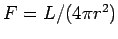 . Similarly, stars of flux are at distance
  , given by
 . If
. If  , then
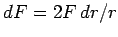 . The volume
of the fraction of a spherical shell that falls within a solid angle
, between and is
. The volume
of the fraction of a spherical shell that falls within a solid angle
, between and is
 . Combining
all this we get for the number of stars per unit solid angle, with flux
between and
. Combining
all this we get for the number of stars per unit solid angle, with flux
between and
 |
(2.1) |
The function
 in the plane of the MW drops much slower
with decreasing than perpendicular to the plane, meaning
in the plane of the MW drops much slower
with decreasing than perpendicular to the plane, meaning  drops much slower within the disk, then perpendicular to it. Which is
because the stars are distributed in a disk around the Sun, not
spherically symmetric. This is how you can determine by
counting stars.
drops much slower within the disk, then perpendicular to it. Which is
because the stars are distributed in a disk around the Sun, not
spherically symmetric. This is how you can determine by
counting stars.
Standard candles are objects with a known absolute
property, for example a known size, or known luminosity. It is then
possible to determine the distance to the standard candle by measuring
their angular size , or apparent luminosity, respectively. A most
important example is that of Cepheid variables. Henrietta Leavitt
studied variable stars in the Magellanic Cloud in 1912. She found a
relation between the period  of the variation
  and the
magnitude
and the
magnitude  of these Cepheids. Since all these stars are at (nearly)
the same distance, this must mean it is actually a relation between the
absolute magnitude
of these Cepheids. Since all these stars are at (nearly)
the same distance, this must mean it is actually a relation between the
absolute magnitude  and . There are many types of variable
stars, but Cepheids have many advantages as standard candles (a) the
shape of their light curve (i.e. luminosity as function of time) is a
very characteristic sawtooth pattern, (b) they are luminous - and so
can be seen out to large distances and (c) the
and . There are many types of variable
stars, but Cepheids have many advantages as standard candles (a) the
shape of their light curve (i.e. luminosity as function of time) is a
very characteristic sawtooth pattern, (b) they are luminous - and so
can be seen out to large distances and (c) the  relation has
little scatter. Unfortunately, they are also relatively rare. RR
Lyrae are similar to Cepheids, but occur in a different type of
star. They are also used as standard candles. Of course, to get an
absolute distance, we need somehow to find the distance to some
Cepheids or RR Lyrae using another method, for example using the
parallax.
relation has
little scatter. Unfortunately, they are also relatively rare. RR
Lyrae are similar to Cepheids, but occur in a different type of
star. They are also used as standard candles. Of course, to get an
absolute distance, we need somehow to find the distance to some
Cepheids or RR Lyrae using another method, for example using the
parallax.
Parallax Stretch your arm, point your index finger upward, and look with your left eye alone toward a distant wall. Now, look with your right eye alone: your finger seems to have moved with respect to the background. You've done (your first?) parallax measurement. If the wall is sufficiently distant then there is a relation between how much your finger appears to move (in degrees, say), the length of your arm, and the distance between your eyes. If you now one distance (e.g. between your eyes), you can determine the other (length of arm).
You can increase the distance between your eyes to twice the distance earth-Sun, by looking at the same object half a year apart. Since one can relatively easily measure angles to a fraction of an arcsec 2.1, we have a new distance unit: the . An object at 1 distance has a parallax of 2arcsec. Let's compute how much this really is. Consider an equi-lateral triangle, with two sides of length 1 third side 1AU. By definition 1/1AU=1arcsecin radians2.2 Hence
 |
(2.2) |
Unfortunately, this literally doesn't get use very far: the distance to even the nearest stars is of this order. We'll come back to the distance scale later.
The parallax and Cepheid variables are the first two steps in the distance ladder, which use one method (e.g. parallax) to calibrate
another distance measure (e.g. Cepheids), that then can be used to
calibrate another distance indicator, and so go to go to greater and
greater distances. The Hubble space telescope recently measured
Cepheids in the Virgo cluster (at a distance of
 ),
thereby providing the first accurate distance to that cluster of
galaxies, and getting an accurate measurement of Hubble's constant in
the process.
),
thereby providing the first accurate distance to that cluster of
galaxies, and getting an accurate measurement of Hubble's constant in
the process.