


 , located at the centre of the MW. In fact, its properties
are quite similar to that of an elliptical galaxy: it is as if there is
a small elliptical galaxy at the centre of each spiral. The surface
brightness profile (in
, located at the centre of the MW. In fact, its properties
are quite similar to that of an elliptical galaxy: it is as if there is
a small elliptical galaxy at the centre of each spiral. The surface
brightness profile (in  per unit area) of this component goes
like
per unit area) of this component goes
like
This is a famous fit to the intensity profile of elliptical galaxies,
introduced by de Vaucouleurs in 1948, and called the `de
Vaucouleurs' or ` '(r-to-the-one-quarter) profile.
(
'(r-to-the-one-quarter) profile.
(
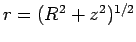 is the 3D distance to the centre.)
 is called the effective radius. Note that
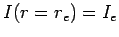 . The
factor 7.6 is chosen such that half of the light comes from stars
within . For the MW,
. The
factor 7.6 is chosen such that half of the light comes from stars
within . For the MW,
 .
.
Although the bulge is bright, we can't see much of it, due to the large amount of obscuring dust (in particular, you can't see it with the naked eye!). The total amount of extinction toward the centre is about 28 magnitudes in the visual! In other spirals, we can see the bulge very well (and recall that the classification of spirals is based on the bulge/disk ratio), but for the MW we need to go the the IR to get a nice picture of it. The MW's bulge is rather elongated with axis ratio 5:3, with strong evidence for a bar.
The stellar content of the bulge is a bit of a mixed bag, with both
very old, low metallicity stars, but also young, metal rich stars. The
mean metallicity is about [Fe/H] , i.e. twice the solar value.
The mass of the bulge is
, i.e. twice the solar value.
The mass of the bulge is
 , with a B-band luminosity
of
, with a B-band luminosity
of
 .
.
![$\displaystyle I(r)=I_e \exp[-7.6(r/r_e)^{1/4}-1]\,.$](img148.png)