


 . The current record holder of low
metallicity has [Fe/H]
. The current record holder of low
metallicity has [Fe/H]
 .
.
Unlike the disk, the halo rotates very little, if at all. As a
consequence, halo stars all appear to move at high velocity (in fact,
rather it is the Sun that is moving at
 ), which is how
they were discovered initially.
), which is how
they were discovered initially.
We know about 150 GCs in the halo. There is some evidence that there are two types, distinguished according to age, metallicity and position. The younger, more metal rich ones have a relatively flattened distribution, and may in fact be associated with the disk. The older, more metal poor ones, are spherically distributed.
There is quite some discussion on the current ages of GCs, with
estimates for the oldest ones varying between 12 and 17Gyears
(1Gyear
 years). For a long time, these estimates were
rather embarrassing for cosmologists, given that this was older than
the best estimates for the age of the Universe. This discrepancy
is now resolved, since the Universe is thought to be older now, and the
ages of the clusters have come down a bit.
years). For a long time, these estimates were
rather embarrassing for cosmologists, given that this was older than
the best estimates for the age of the Universe. This discrepancy
is now resolved, since the Universe is thought to be older now, and the
ages of the clusters have come down a bit.
If the absolute age of the GCs is difficult to estimate, relative ages are more secure. And so it is rather more secure to say that there is a relatively large spread in the ages of the MW's GCs. Presumably, this tells us something about how the MW formed.
The density of halo stars (and of GCs as well) falls spherically as
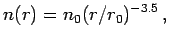 |
(3.3) |
 . The total mass is actually quite low,
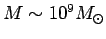 and
luminosity
and
luminosity
 , or only 10 per cent of that of the disk.