


 |
Suppose you're on a circular orbit with radius  around the MW, and
you measure the velocities of stars around you. For simplicity, assume
all stars are also on circular orbits. Stars on orbits with radius
around the MW, and
you measure the velocities of stars around you. For simplicity, assume
all stars are also on circular orbits. Stars on orbits with radius
 will go faster than you do, and so will over take you, and the
opposite for stars with
will go faster than you do, and so will over take you, and the
opposite for stars with  . Jan Oort computed how the velocities
you measure for these stars depend on their distance and the direction
you see them in.
. Jan Oort computed how the velocities
you measure for these stars depend on their distance and the direction
you see them in.
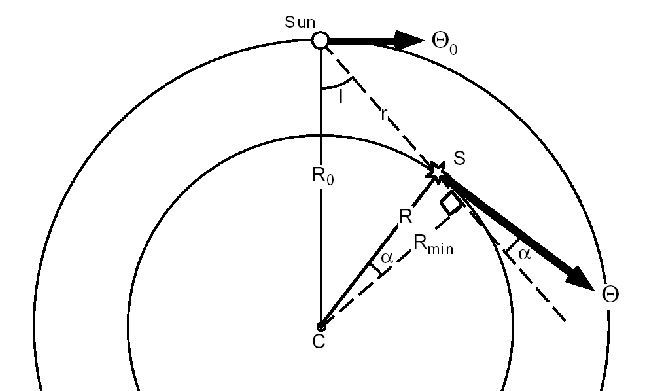
For the geometry, look at Figure (5.1)5.2. To keep the notation the same, let's
call the circular velocity at the position of the observer  ,
and at the position of the star
,
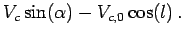
and at the position of the star  . The radial and tangential
velocity of the star with respect to the observer (at the position of
the Sun) are
. The radial and tangential
velocity of the star with respect to the observer (at the position of
the Sun) are
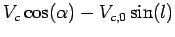
Now, in the right-angled triangle on the figure, you can convince yourself that
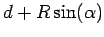 |
 |
 |
|
 |
|
 |
|
 |
|
 |
(5.3) |
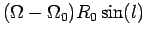
where  is the angle Sun-MW Centre-Star. Combining these
equations gives
is the angle Sun-MW Centre-Star. Combining these
equations gives
where
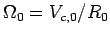 is the angular velocity of the observer,
and
is the angular velocity of the observer,
and
 the angular velocity of the star. If
  is
small, we can perform a Taylor expansion to find
is
small, we can perform a Taylor expansion to find
 and substitute this in the
previous expression. Finally we can introduce Oort's constants
and substitute this in the
previous expression. Finally we can introduce Oort's constants
We'll discuss in a moment how the measured values are found. With these definitions we obtain after some algebra,
 |
|
 |
|
 |
|
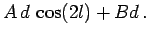 |
(5.6) |
Let's see what this means. For a star toward the galactic centre or
anti-centre ( and
and  respectively), we find the radial
velocity to be zero, and the tangential velocity to be
respectively), we find the radial
velocity to be zero, and the tangential velocity to be  . For
example with
. For
example with
 ,
,
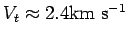 .
.
To measure  and
and  , we need to measure the radial and tangential
velocities of stars of known distance.
, we need to measure the radial and tangential
velocities of stars of known distance.
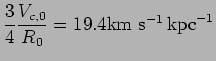
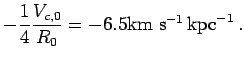
Finally, let's see what we would expect to find for a Keplerian disk,
for which
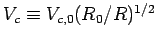 , and hence
 . At the position of the Sun, we know
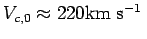 and
and
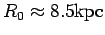 hence
hence
 |
|
 |
|
 |
|
 |
(5.7) |
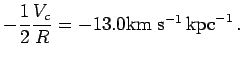
This does not compare well with the measured values in
Eqs.(5.5). Assuming we got  correct, let's compare the
measured and computed values for
correct, let's compare the
measured and computed values for  ,
,
 |
|
 |
|
 |
|
 |
(5.8) |
So what appears to be wrong is that the circular velocity, as computed
for Keplerian fall-off, decreases much more rapidly with increasing
 , than the values measured from Oort's constants. We've assumed
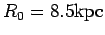 , but for the two values to agree, we would require
to be larger by a factor 6! Clearly, the discrepancy is much larger
than the uncertainties in our values of either or . We shall
see later that there is other evidence that suggests a much more
dramatic failure of our underlying assumptions.
, but for the two values to agree, we would require
to be larger by a factor 6! Clearly, the discrepancy is much larger
than the uncertainties in our values of either or . We shall
see later that there is other evidence that suggests a much more
dramatic failure of our underlying assumptions.
We've so far assumed stars to be on exactly circular orbits. This is of
course only an approximation, and real stars will have velocities which
differ slightly from  : they will have (small) peculiar
velocities in all three Cartesian directions. The reference system that
is on a circular orbit with velocity is called the local
standard of rest (LSR)5.3, and, for example the Sun moves with a velocity of
: they will have (small) peculiar
velocities in all three Cartesian directions. The reference system that
is on a circular orbit with velocity is called the local
standard of rest (LSR)5.3, and, for example the Sun moves with a velocity of
 with respect to its LSR. This is called the solar
motion. To determine and , we need to measure
with respect to its LSR. This is called the solar
motion. To determine and , we need to measure  and
and  as a function of
  and
and  statistically, and take into account
that we also need to determine the solar motion.
statistically, and take into account
that we also need to determine the solar motion.
When Oort did his measurements of the constants and , he
discovered that some stars had very large deviations from the expected
values of and . He called them high velocity stars. He
also correctly identified their origin, they are stars in the MW halo.
Unlike the disk, the halo does not rotate, and so the high velocities
of these stars are due to the rotation velocity of the Sun.
 and
radius
and
radius  , and galactic
longitude
, and galactic
longitude  and radius



![$\displaystyle -{1\over 2} \left[ {dV_c\over dR}\vert _{R_0} -
{V_{c,0}\over R_0...
...]\approx 14.4\pm 1.2{\hbox{\rm km}}\,{\hbox{\rm s}}^{-1}\,{\hbox{\rm kpc}}^{-1}$](img298.png)

