


Here is a simplified way how to do this. First let me prove that for a uniform disk, the force on a star is independent of the distance to the disk.
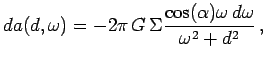
As an intermediate step, let's compute the gravitational acceleration
on a star, at distance  from the centre of a ring of matter with
radius
from the centre of a ring of matter with
radius  and thickness
  , and of surface density
 . From symmetry, the acceleration is toward the middle of the ring,
and it has magnitude
. From symmetry, the acceleration is toward the middle of the ring,
and it has magnitude
 |
(5.12) |
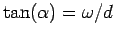
where  is the angle at the position of the star, between the
vertical and the ring, so
is the angle at the position of the star, between the
vertical and the ring, so
 . Now the acceleration
due to the whole disk is found by summing over all such rings, hence
. Now the acceleration
due to the whole disk is found by summing over all such rings, hence
 |
(5.13) |
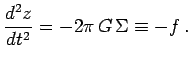
independent of ! So the equation of motion for the star is
 |
(5.14) |
This is just the same as that for a ball thrown vertically on the
earth's surface, so the solution is
 . From this, one can easily obtain the fraction of stars
you expect that have
. From this, one can easily obtain the fraction of stars
you expect that have  between
![$ [z_1,z_1+\delta]$](img348.png) and between
and between
![$ [z_2,z_2+\delta]$](img349.png) , which depends only on
, which depends only on  . So, if you measure this from
your data, you can determine . The value Oort found is called
the `Oort limit' since the MW disk needs to have at least this
surface density.
. So, if you measure this from
your data, you can determine . The value Oort found is called
the `Oort limit' since the MW disk needs to have at least this
surface density.