


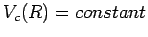
 , it means there must
be more mass in the outskirts of spirals than we've assumed so
far. Let's compute how much more.
, it means there must
be more mass in the outskirts of spirals than we've assumed so
far. Let's compute how much more.
Assume the density  of the MW is
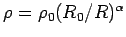 ,
where
,
where  and
and  are constants. For such a density distribution,
the mass within a given radius
are constants. For such a density distribution,
the mass within a given radius  ,
,
 . Computing
  , you easily find that a
flat rotation curve requires
, you easily find that a
flat rotation curve requires  , hence
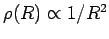 is required for a flat rotation curve. And so, although the light
density drops significantly in the outer parts of the MW, the mass density drops much slower with increasing .
is required for a flat rotation curve. And so, although the light
density drops significantly in the outer parts of the MW, the mass density drops much slower with increasing .
More recently, rotation curves have been measured using the 21-cm line
in many other spiral galaxies, with always the same result: although
the rotation curve rises from the centre outward, at sufficiently large
radius  it invariably becomes flat, even though most of the light
is enclosed within . So why don't we see this mass? Two solutions
seem possible. Firstly, for some strange reason, the mass-to-light
ratio of the stars outside increases very much, so that the
little amount of light we see, actually represents much more mass than
we think. Or secondly, there is some type of invisible mass - dark
matter - that dominates the mass-density in the outer parts of spiral
galaxies.5.5 Both seem rather contrived, yet
evidence for dark matter seems to reoccur again and again in other
places as well. Note that this dark matter needs to be (1) massive, (2)
invisible, i.e. it does not absorb light, nor does it emit light, it simply does not interact with photons.
it invariably becomes flat, even though most of the light
is enclosed within . So why don't we see this mass? Two solutions
seem possible. Firstly, for some strange reason, the mass-to-light
ratio of the stars outside increases very much, so that the
little amount of light we see, actually represents much more mass than
we think. Or secondly, there is some type of invisible mass - dark
matter - that dominates the mass-density in the outer parts of spiral
galaxies.5.5 Both seem rather contrived, yet
evidence for dark matter seems to reoccur again and again in other
places as well. Note that this dark matter needs to be (1) massive, (2)
invisible, i.e. it does not absorb light, nor does it emit light, it simply does not interact with photons.
Already in the 1930s, the Swiss astronomer Fritz Zwicky said that the galaxies in a cluster of galaxies move too fast for the amount of matter accounted for in the galaxies themselves. In fact, they moved so fast that gravity could not contain them to remain inside the cluster. So Zwicky postulated that there must be some type of invisible matter inside galaxy clusters. We'll discuss evidence for dark matter in elliptical galaxies, in clusters, and finally in the Universe as a whole. The case is sufficiently strong that experiments have been set-up all over the world, to try to detect this mysterious type of mass in the laboratory.