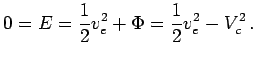
and the escape speed
  . If we
assume all mass
. If we
assume all mass  of the MW is interior to the solar radius
  6.3, then
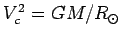 , and the potential
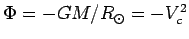 . The
velocity of a star just able to escape from the gravitational well is
the escape speed, . So since that star has zero total
energy,
. The
velocity of a star just able to escape from the gravitational well is
the escape speed, . So since that star has zero total
energy,
So in this case,
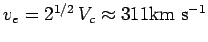 (Using
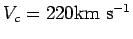 .) So for a point mass model of the MW, these high
velocity stars cannot be bound to the MW - suggesting once more the
presence of more mass in the outskirts of the MW than expected, given
the rapid decrease in the distribution of light.
.) So for a point mass model of the MW, these high
velocity stars cannot be bound to the MW - suggesting once more the
presence of more mass in the outskirts of the MW than expected, given
the rapid decrease in the distribution of light.