 |
(6.7) |
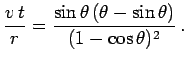
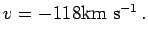
The negative sign means that Andromeda is moving toward the MW. This may be surprising, given that most galaxies are moving apart with the general Hubble flow. The fact that Andromeda is moving toward the MW is presumably because their mutual gravitational attraction has halted, and eventually reversed their initial velocities. Kahn and Woltjer pointed out in 1952 that this leads to an estimate of the masses involved.
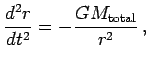
Since M31 and the MW are by far the most luminous members of the LG we can neglect in the first instance the others, and treat the two galaxies as an isolated system of two point masses. Since M31 is about twice as bright as the MW, and given that they are so similar, it is presumably also about twice as massive. If we further assume the orbit to be radial, then Newton's law gives for the equation of motion
 |
(6.8) |
where
 is the sum of the two masses. Initially, at
  , we can
take
, we can
take  (since the galaxies were close together at the Big Bang).
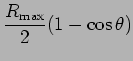
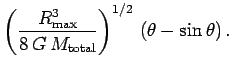
The solution can be written in the well known parametric form
 |
 |
 |
|
 |
|
 |
(6.9) |
The distance  increases from 0 (for
  ) to some maximum
value
) to some maximum
value
 (for
(for
 ), and then decreases again. The
relative velocity
), and then decreases again. The
relative velocity
 |
(6.10) |
The last three equations can be combined to eliminate
,  and
, to give
and
, to give
 can be measured from Doppler shifts, and
 from
Cepheid variables. For
from
Cepheid variables. For  we can take the age of the
Universe. Current estimates of are quite accurate6.6, but even using
ages of the oldest MW stars,
we can take the age of the
Universe. Current estimates of are quite accurate6.6, but even using
ages of the oldest MW stars,
 gives an interesting
result. Using these numbers, we can solve the previous equation
(numerically) to find
gives an interesting
result. Using these numbers, we can solve the previous equation
(numerically) to find
 radians, assuming M31 is on
its first approach to the MW6.7.
radians, assuming M31 is on
its first approach to the MW6.7.
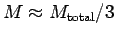
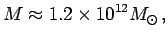
Substituting yields
 , and
hence for the MW mass,
, and
hence for the MW mass,
 |
(6.12) |
Since the luminosity of the MW (in the V band) is
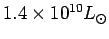 , the corresponding mass-to-light ratio for the MW is
around
, the corresponding mass-to-light ratio for the MW is
around
 . Furthermore, the estimate of
  is increased if
the orbit is not radial, or M31 and the MW have already had one (or
more) pericenter passages since the Big Bang.
is increased if
the orbit is not radial, or M31 and the MW have already had one (or
more) pericenter passages since the Big Bang.
If all stars in the MW and M31 were solar mass stars, we would expect
 . Now even in the solar neighbourhood, most stars are less
massive than the sun, and so the mass-to-light ratio for the stars is about 3 or so6.8. So the very large mass inferred from the LG
dynamics strongly corroborates the evidence from rotation curves and
Oort's constants, that most of the mass in the MW (and presumably also
in M31) is dark.
. Now even in the solar neighbourhood, most stars are less
massive than the sun, and so the mass-to-light ratio for the stars is about 3 or so6.8. So the very large mass inferred from the LG
dynamics strongly corroborates the evidence from rotation curves and
Oort's constants, that most of the mass in the MW (and presumably also
in M31) is dark.
From these numbers, we can also estimate the extent  of such a putative
dark halo. If the the circular velocity
of such a putative
dark halo. If the the circular velocity
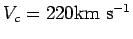 out to , then
from
out to , then
from
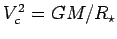 we find
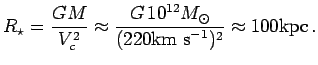 |
(6.13) |
If, as is more likely, the rotation speed eventually drops below
220km s , then
  is even bigger. Hence the extent of the dark matter
halo around the MW and M31 is truly enormous. Recall that the size of
the stellar disk is of order 20kpc or so, and the distance to M31
is even bigger. Hence the extent of the dark matter
halo around the MW and M31 is truly enormous. Recall that the size of
the stellar disk is of order 20kpc or so, and the distance to M31
 . So the dark matter haloes of the MW and M31 may almost overlap.