The fact that a stellar population appears blue either because it is
young, or because it is metal poor, is called the age-metallicity
degeneracy: just observing the colour of a population, you cannot tell
a young but metal rich population apart from an old but metal poor
one. To make sure, you have to have independent constraints on th
metallicity  , for example from stellar spectra, or, the astronomer's
favourite, from HII regions.
, for example from stellar spectra, or, the astronomer's
favourite, from HII regions.
Dust and gas Although I said that a characteristic
difference between Es and Ss is that Es don't contain dust or gas, and
have no star formation, this is of course not complete true, they
usually have some, but much less than Ss. Many Es contain strong dust
lanes, the Sombrero galaxy is a beautiful
example (Fig. 7.6). Often, there is almost no connection
between the orientation of the dust lane, and any other of the galaxy's
parameters. It is thought that such dust lanes are evidence that the E
recently swallowed a small galaxy. In fact, one sometimes observes very
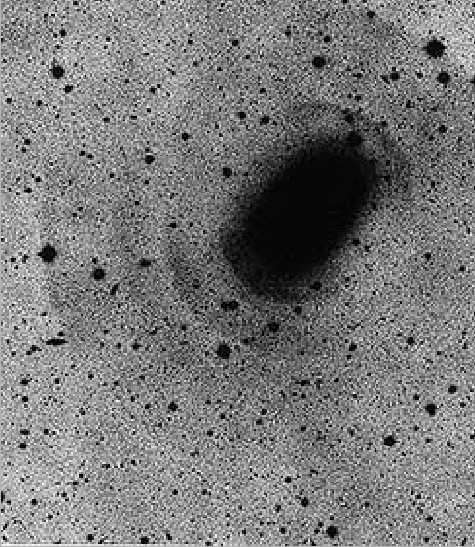
faint rings of stars around an E, and also this could be the result of
`galactic cannibalism'. A good example is shown in
Figure (7.7).
 |