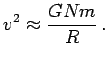
To see that this would make a huge difference, consider the case where
a single star (a test particle) moves through a smooth density
distribution with spherically symmetric density distribution  ,
where
,
where
 . In such a time-independent potential both the angular
momentum,
. In such a time-independent potential both the angular
momentum,
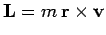 , and energy,
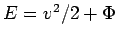 , of the star will be conserved along its orbit. Now
suppose such a density distribution to be represented by a finite
number of stars. As our test star moves along its orbit, it will be
deflected by encounters with these other stars. In such a situation,
neither
, of the star will be conserved along its orbit. Now
suppose such a density distribution to be represented by a finite
number of stars. As our test star moves along its orbit, it will be
deflected by encounters with these other stars. In such a situation,
neither  nor
nor  will be conserved, and so the properties of
its orbit will change in time. Clearly, the longer the star orbits in
this density distribution, the more will differ from its initial
value. The relaxation time
will be conserved, and so the properties of
its orbit will change in time. Clearly, the longer the star orbits in
this density distribution, the more will differ from its initial
value. The relaxation time  is a measure of how long the star
remembers its initial energy. We will see that the more stars are
there in the galaxy, the longer is the relaxation time. You might have
expected this, since for an infinite number of stars, the density is
smooth, and are constant, and hence
is a measure of how long the star
remembers its initial energy. We will see that the more stars are
there in the galaxy, the longer is the relaxation time. You might have
expected this, since for an infinite number of stars, the density is
smooth, and are constant, and hence
 .
.
To estimate , we will compute the change in energy  of a
star due to a single encounter with another star, as function of the
impact parameter
of a
star due to a single encounter with another star, as function of the
impact parameter  and impact velocity
  (the velocity at infinity,
before the encounter started), and then sum over encounters. This
derivation was first done by Chandrasekhar, the derivation here is
slightly different from BT (p. 188).
(the velocity at infinity,
before the encounter started), and then sum over encounters. This
derivation was first done by Chandrasekhar, the derivation here is
slightly different from BT (p. 188).
Let's compute the change in velocity
 of this star. Because
we want to treat the case where the effect of encounters is small,
we'll approximate the orbit as a straight line, traversed with constant
velocity . The force perpendicular to the orbit is
of this star. Because
we want to treat the case where the effect of encounters is small,
we'll approximate the orbit as a straight line, traversed with constant
velocity . The force perpendicular to the orbit is
![$\displaystyle \hbox{$\bf F$}_\perp = {Gm^2\over b^2+(vt)^2}\,\cos(\theta)\approx {Gm^2\over b^2}\,\left[1+({vt\over b})^2\right]^{-3/2}\,,$](img497.png) |
(8.1) |
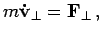
where I've assumed equal mass stars. The approximation
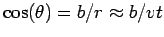 is valid for small. Combined with Newton's law
 |
(8.2) |
yields the net change
 over a single encounter:
Thus the change is roughly equal to the force at closest approach,
 , times the time this force acts,
 . Because
of symmetry, encounters are equally likely to change the velocity in
the positive direction, as in the negative direction. Therefore the
mean change
. Because
of symmetry, encounters are equally likely to change the velocity in
the positive direction, as in the negative direction. Therefore the
mean change
 . We will therefore
consider the rate of change of
. We will therefore
consider the rate of change of
 .
.
To compute the rate of change of
, due to many
encounters, proceed as follows. Suppose the test star moves with
velocity through a stellar system with radius  , and (uniform)
number density of stars,
, and (uniform)
number density of stars,  . When travelling for a time
  ,
the number of encounters with impact parameter between and
,
the number of encounters with impact parameter between and  ,
is simply the volume of the cylindrical shell,
,
is simply the volume of the cylindrical shell,
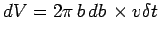 , times the number density of stars, . Here,
  is the length of the cylinder,
 is the surface area of the
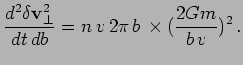
shell. Since each of these encounters leads to a change in velocity
squared by an amount
, we find for the rate of
change
is the surface area of the
shell. Since each of these encounters leads to a change in velocity
squared by an amount
, we find for the rate of
change
 |
(8.4) |
This is the product of the rate of encounters,
 , with the
velocity change per encounter. Now we can integrate over impact
parameter to obtain for the rate of change in velocity
, with the
velocity change per encounter. Now we can integrate over impact
parameter to obtain for the rate of change in velocity
 |
(8.5) |
Unfortunately this integral diverges, both at small impact parameters
(which are few in number, but cause large velocity changes), and at
large impact parameters (which cause small velocity changes yet are
very numerous). How to overcome this divergence?
For a real stellar system, there cannot be encounters with impact
parameter larger than the size of the system. For the smallest
impact parameter , we can take
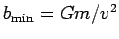 , for which the
change in velocity is comparable to the initial velocity
(cfr.Eq. 8.3). Recall that our derivation assumed small changes
anyway. With this caveat in mind we replace the previous equation by
, for which the
change in velocity is comparable to the initial velocity
(cfr.Eq. 8.3). Recall that our derivation assumed small changes
anyway. With this caveat in mind we replace the previous equation by
We can simplify this by assuming that the stellar system is in virial
equilibrium, in which case the kinetic energy of all stars combined,
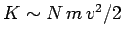 is half of the potential energy,
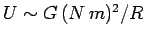 , where
  is the mass of a star. Therefore
Combining this with the expression for
 it is easy to show
that
it is easy to show
that
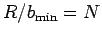 , the total number of stars.
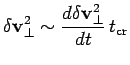
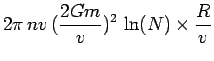
So far we have computed the rate of change of the velocity. To
judge whether the change of velocity is large or small, we can multiply
the rate with the crossing time of the system,
 . It is a measure of how long it takes to cross the stellar system,
on average. The velocity change during a single crossing of the stellar
system is therefore
. It is a measure of how long it takes to cross the stellar system,
on average. The velocity change during a single crossing of the stellar
system is therefore
 |
 |
 |
|
|
 |
(8.8) |
The first line combines Eq.(8.6) with our finding
and the definition of the crossing time. The second step
assumes virial equilibrium, Eq. (8.7). We are finally in a
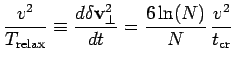
position to define the relaxation time
 , as the
time it takes for encounters to change the velocity by order of itself,
hence
, as the
time it takes for encounters to change the velocity by order of itself,
hence
 |
(8.9) |
hence we get as our final result
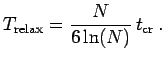 |
(8.10) |
For systems of the same mass and size, and hence a given
crossing time, we find that the relaxation time increases with  as
as
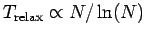 . Put differently, the effect of
encounters decreases with increasing particle numbers as
. Put differently, the effect of
encounters decreases with increasing particle numbers as  .
.
For a Globular Cluster with  say,
say,  , and
, and
 ,
,
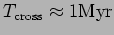 . Putting in the numbers8.1, we find
 years, much smaller than the ages of the
stars in the GC. Hence we expect stellar encounters to be important in
shaping the structure of GCs.
years, much smaller than the ages of the
stars in the GC. Hence we expect stellar encounters to be important in
shaping the structure of GCs.
However, for a big elliptical galaxy,  , say. The crossing
time is of order
, say. The crossing
time is of order
 , and
, and
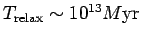 which is much larger than the age of the
Universe (
which is much larger than the age of the
Universe (
 ). Therefore we can completely neglect
encounters between stars, when describing the equation of stellar
dynamics in a galaxy, and derive fluid-like equations for the behaviour
of a galaxy. The stars will be like the gas particles in the usual gas
equations. This is what we'll do next.
). Therefore we can completely neglect
encounters between stars, when describing the equation of stellar
dynamics in a galaxy, and derive fluid-like equations for the behaviour
of a galaxy. The stars will be like the gas particles in the usual gas
equations. This is what we'll do next.