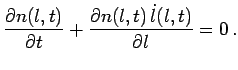
Suppose you're standing on a hill above a tunnel on a motor way, and you count the number of cars entering the tunnel on one side and the number that leaves the tunnel on the other side.
If  is the number density of cars in the tunnel (in cars per km
say), and
is the number density of cars in the tunnel (in cars per km
say), and  is the length of the tunnel, then the number of
cars in the tunnel is obviously
is the length of the tunnel, then the number of
cars in the tunnel is obviously
 . The change in
  between two times is
![$\displaystyle \Delta N=[n(l,t+\Delta t)-n(l,t)]\,\Delta l\approx {\partial n(l,t)\over\partial t}\,\Delta l\,\Delta t\,.$](img541.png) |
(8.11) |
Assuming there is no other exit, this is also the change between the number of cars entering and leaving the tunnel,
![$\displaystyle \Delta N=[n(l,t)\dot l(l,t)-n(l+\Delta l,t)\dot l(l+\Delta l,t)]\...
...t\approx -{\partial n(l,t)\,\dot l(l,t)\over \partial l}\,\Delta l\,\Delta t\,.$](img542.png) |
(8.12) |
The first term
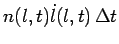 is the number of cars entering
the tunnel in time
is the number of cars entering
the tunnel in time  , the second term is how many are leaving
in that time.
, the second term is how many are leaving
in that time.
 obviously denotes the speed of the cars.
Combining these two equation, we get the following continuity equation:
A little bit of thought shows that, in a N-dimensional case (spaceships through a worm-hole?), the more general equation would be
so there is a partial derivative
 for every
Cartesian coordinate
for every
Cartesian coordinate  , and is multiplied by
  in the
second term, which is the velocity of the spaceships in the
in the
second term, which is the velocity of the spaceships in the
 -direction.