around a position
 , that have velocity in
a small interval
, that have velocity in
a small interval
 around a given velocity
 . This density
of stars,
. This density
of stars,
 , is called the distribution
function. If we don't care about the velocity of stars, then we can
integrate
, is called the distribution
function. If we don't care about the velocity of stars, then we can
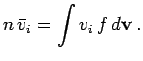
integrate  over all velocities, to obtain the density of stars,
 |
(8.15) |
Now we only have to realise that stars acts as our cars on the motor
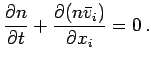
way, and hence should satisfy the continuity equation
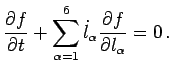
(8.14). The way to do it is to substitute for the  coordinates in that equation the positions and velocities of the stars,
 |
 |
 |
|
 |
|
 |
(8.16) |
where I've written
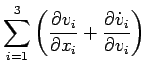 for the gravitational acceleration
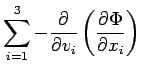 of the star.
So this
 vector has 6 coordinates,
 for
for
 , and
, and
 for
for
 . Now these coordinates are very special, since
 |
 |
 |
|
|
 |
||
|
 |
(8.17) |
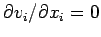
Here,
 since the positions and velocities
of the stars are independent variables, and the second term is zero
because the gravitational acceleration
since the positions and velocities
of the stars are independent variables, and the second term is zero
because the gravitational acceleration
 does
not depend on velocity.
does
not depend on velocity.
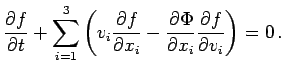
We can use this equation to simplify the continuity equation, and to obtain
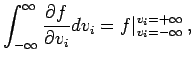 |
(8.18) |
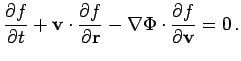
Rewriting in terms of positions and velocities, we obtain the collisionless Boltzmann equation,
or in vector notation