


Sometimes though, one of the filters used is a narrow-band
filter, for example H or O[III]. These filters block all light
which is not in a narrow range around the hydrogen H
transition, or a transition in doubly ionised oxygen. Combining such a
narrow-band image with images made with others filters produces a false colour image, i.e. the colour of the object is not how
your eye would see it, but the colour coding has been chosen to bring
out a particular feature - for example H emission. The really
pretty colour pictures of Planetary Nebulae are false colour images.
or O[III]. These filters block all light
which is not in a narrow range around the hydrogen H
transition, or a transition in doubly ionised oxygen. Combining such a
narrow-band image with images made with others filters produces a false colour image, i.e. the colour of the object is not how
your eye would see it, but the colour coding has been chosen to bring
out a particular feature - for example H emission. The really
pretty colour pictures of Planetary Nebulae are false colour images.
Luminosity, flux and surface brightness
A star emits a certain amount of energy per unit time. For example the
Sun has a luminosity
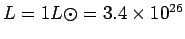 W. This
quantity is not observable however: what we can measure is how much of
this energy we receive, per unit time, per unit surface area (assuming
you put the surface perpendicular to the radiation!), at a given
distance from the source. The observable quantity, energy received per
unit time per unit of surface area, is called flux. Clearly the
flux will depend both on the luminosity of the star, and on its
distance. How?
W. This
quantity is not observable however: what we can measure is how much of
this energy we receive, per unit time, per unit surface area (assuming
you put the surface perpendicular to the radiation!), at a given
distance from the source. The observable quantity, energy received per
unit time per unit of surface area, is called flux. Clearly the
flux will depend both on the luminosity of the star, and on its
distance. How?
Consider a sphere of radius  , with the star at the centre. Since the
star will distribute all of its energy equally over the surface of the
sphere, the flux
, with the star at the centre. Since the
star will distribute all of its energy equally over the surface of the
sphere, the flux
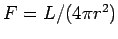 . (As an exercise, find the unit of
flux).
. (As an exercise, find the unit of
flux).
It is the flux of the star that determines how bright it appears
to be. Indeed, star A may be brighter than star B, either because it is
more luminous,
 , or because it is nearer to us,
 .
.
Although  is in principle observable, in practise astronomers
express brightness in terms of magnitudes
is in principle observable, in practise astronomers
express brightness in terms of magnitudes  , where the apparent
magnitude
, where the apparent
magnitude
 , where
  is some constant that
depends on the magnitude system used. Since the depends on
distance, so does , it is not an intrinsic quantity of the star -
hence `apparent magnitude'. The absolute magnitude,
is some constant that
depends on the magnitude system used. Since the depends on
distance, so does , it is not an intrinsic quantity of the star -
hence `apparent magnitude'. The absolute magnitude,  , is the
apparent magnitude when
, is the
apparent magnitude when  pc.
pc.
Since a galaxy contains many stars, we can also talk about its luminosity, and the flux we receive from it. However, because galaxies are spatially extended1.2, we can also try to measure what fraction of the flux comes from the centre of the galaxy and what fraction comes from the outer parts, say. This gives rise to the term surface brightness.
Consider a small patch of galaxy, namely that part contained in a
(small) solid angle  . Observationally we can measure the flux,
 , of light, coming from the part of the galaxy contained within
. The quantity
, of light, coming from the part of the galaxy contained within
. The quantity
 is called surface
brightness (SB), and so it has dimensions
energy/time/area/steradian.1.3
is called surface
brightness (SB), and so it has dimensions
energy/time/area/steradian.1.3
The surface brightness of a galaxy does not depend on its distance. To
see this, assume that the patch of galaxy contained within
contains  stars, with mean luminosity
  , when it is at a distance
. The surface brightness SB=
, when it is at a distance
. The surface brightness SB=
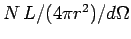 . Now increase
the distance to the galaxy by a factor of 2. The flux from each
individual star will decrease by a factor
. Now increase
the distance to the galaxy by a factor of 2. The flux from each
individual star will decrease by a factor  , since
 . However the number of stars within will increase
by a factor , since the physical size of the patch enclosed by
will double when doubles. Hence SB is distance
independent1.4, therefore whereas with brightness there was
an intrinsic quantity (luminosity), and an observable one (flux),
there is only one surface brightness.
. However the number of stars within will increase
by a factor , since the physical size of the patch enclosed by
will double when doubles. Hence SB is distance
independent1.4, therefore whereas with brightness there was
an intrinsic quantity (luminosity), and an observable one (flux),
there is only one surface brightness.
A galaxy's SB depends on its distribution of stars.
Assume a face-on galaxy at distance has a surface density  of stars (in stars/pc
 , say), all with the same luminosity . The
surface area of galaxy
, say), all with the same luminosity . The
surface area of galaxy  , contained within a solid angle ,
is
, contained within a solid angle ,
is
 . Therefore the number,
  , of stars within
is
, of stars within
is
 . The flux received from
a single star is
. The flux received from
a single star is
 , and therefore the flux received from
all stars within is
, and therefore the flux received from
all stars within is
 . The surface
brightness is the flux per unit solid angle, is
. The surface
brightness is the flux per unit solid angle, is
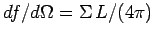 is
distance independent, as we saw before.
is
distance independent, as we saw before.