


 , then the kinetic energy of the system of
  galaxies is
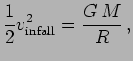 |
(9.1) |
where 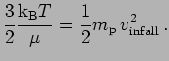 is the total mass of the cluster galaxies, and the
velocity dispersion
is the total mass of the cluster galaxies, and the
velocity dispersion 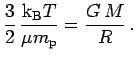 is defined as
 |
(9.2) |
The potential energy in the system is of order
 |
(9.3) |
where  is a measure of the size of the system. When the system is in
virial equilibrium,
is a measure of the size of the system. When the system is in
virial equilibrium,  hence
hence
 |
(9.4) |
Note that the measured rms velocity is just the line-of-sight
one, say
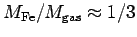 , but if
the velocities are isotropic, then
, but if
the velocities are isotropic, then
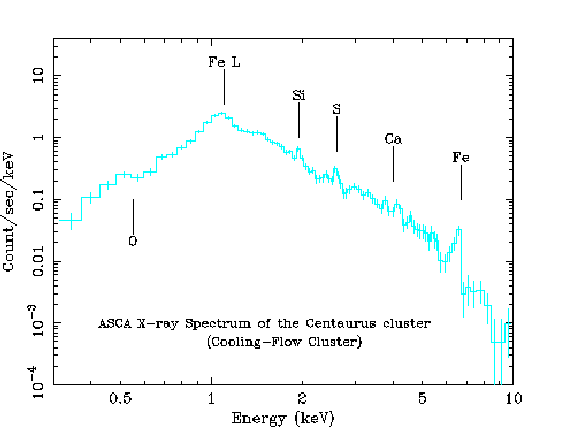 . So from
that, and from an estimate of , one can estimate the dynamical mass
. So from
that, and from an estimate of , one can estimate the dynamical mass
 .
.
Zwicky estimated the masses of the galaxies, and compared the result with the dynamical mass. Not only was the dynamical mass much larger, the velocities of the cluster galaxies was so high that, given the amount of mass inferred to be in the galaxies, the cluster was not even a gravitationally bound system. Left on its own, it would cease to be a high density region of galaxies on a short time scale because the galaxies would fly apart very rapidly. So either clusters were just chance superpositions of galaxies, or there was much more mass in them than was inferred from just the galaxies. Zwicky concluded that most of the mass in clusters must be invisible.