


From the X-ray intensity distribution, one can also estimate the amount
of hot gas present in the cluster. From modelling the colours of the
galaxies, one can estimate the mass in stars. Comparison of these two
shows that hot gas is the dominant baryonic mass by a large
factor. So most of the baryonic mass in a cluster of galaxies is
actually in hot gas and not in galaxies at all.
The temperature of the gas is so high that it balances the gravitational
force of the dark matter in the cluster. It gets to this high
temperature by shock heating. This is how it works: as the
cluster is accreting matter from its surroundings, newly accreted gas
falls into the cluster at high velocity. The velocity is high, because
the gas has been accelerated by the gravitational force from the
tremendous amount of mass in the cluster. The high velocity gas slams
into the stationary hot gas and converts most of its kinetic energy
into thermal energy: this is an accretion shock.
Suppose a parcel of gas starts at infinity with zero velocity, and
falls into a cluster with mass  and radius
  . By the time it
reaches the outskirts of the cluster at radius it will have an
in fall velocity
. By the time it
reaches the outskirts of the cluster at radius it will have an
in fall velocity
 |
(9.5) |
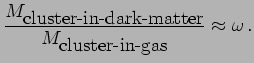
where I've used energy conservation. When it hits the cluster gas, it
will convert this kinetic energy into thermal energy, hence it will
be heated to a temperature 
 |
(9.6) |
Here,  is the mean molecular weight of the gas. Combining the last
two equations, we find that the temperature of the cluster will be
is the mean molecular weight of the gas. Combining the last
two equations, we find that the temperature of the cluster will be
 |
(9.7) |
This temperature is called the virial temperature.
Where does all this gas come from? The X-rays we observe from clusters
imply that the hot gas is loosing energy and hence is cooling. So from
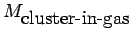
the observed X-ray luminosity, we can estimate the cooling time of the
gas
 ,
,
 |
(9.8) |
Given the present cooling rate,  , the gas will have lost it's
thermal energy after a cooling time,
. The measured
values of
turn out to be longer than the age of the
Universe for most clusters9.2. This means that once the gas gets
hot it will remain hot, and cannot form into galaxies anymore. So
clusters of galaxies are in fact regions where galaxy formation is
strongly suppressed because the gas is too hot to cool and form
stars.
, the gas will have lost it's
thermal energy after a cooling time,
. The measured
values of
turn out to be longer than the age of the
Universe for most clusters9.2. This means that once the gas gets
hot it will remain hot, and cannot form into galaxies anymore. So
clusters of galaxies are in fact regions where galaxy formation is
strongly suppressed because the gas is too hot to cool and form
stars.
But why did it not form galaxies before it became hot? This is actually a rather hotly debated issue at the moment, but here's a hint: