


Suppose the Universe starts-out smooth, with a (nearly) constant ratio
 of dark matter to gas:
 |
(9.9) |
As a cluster starts to form, the density of dark matter and of gas will increase. But the potential well of the cluster is so deep, that it is probably a good approximation to assume that none of the dark matter, nor the gas, can ever escape the gravitational pull of the cluster. This means that the ratio of the total dark matter to total gas mass in the cluster
 |
(9.10) |
We could do slightly better by also including the mass in stars - but that is a small correction anyway.
So we can find by determining
 from dynamics, and
 from the X-ray emissivity. The result is
 .
.
Next we need an estimate of the mean baryonic density,
 . An elegant way is by determining the Deuterium abundance
of gas9.4.
Deuterium is produced in the Big Bang and destroyed in stellar
burning. So if we find Deuterium, we know it is left over from the Big
Bang. Analysis of the spectra of quasars (we will discuss quasars soon)
allows us to measure the Deuterium abundance quite accurately. How does
this help us? The missing link is that the gas density
determines how much Deuterium is produced in
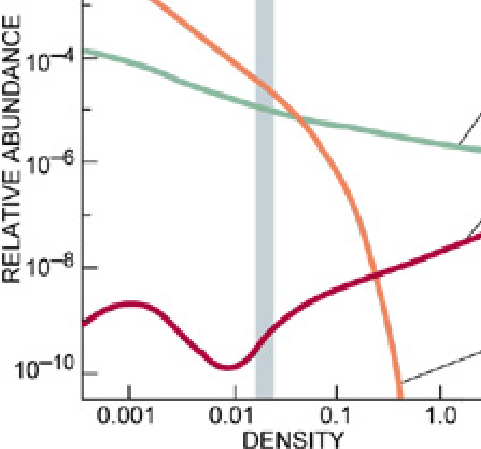
the Big Bang. Figure 9.2 shows how the abundance (with
respect to hydrogen) of elements produced in Big Bang nucleo-synthesis,
as function of the baryon density. The result is that the mean baryon
density corresponds to of order
. An elegant way is by determining the Deuterium abundance
of gas9.4.
Deuterium is produced in the Big Bang and destroyed in stellar
burning. So if we find Deuterium, we know it is left over from the Big
Bang. Analysis of the spectra of quasars (we will discuss quasars soon)
allows us to measure the Deuterium abundance quite accurately. How does
this help us? The missing link is that the gas density
determines how much Deuterium is produced in
the Big Bang. Figure 9.2 shows how the abundance (with
respect to hydrogen) of elements produced in Big Bang nucleo-synthesis,
as function of the baryon density. The result is that the mean baryon
density corresponds to of order
 hydrogen atoms per cm
 (i.e.
(i.e.
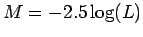 g
cm. So the density of paper/density of the screen you are
reading this on, is about
g
cm. So the density of paper/density of the screen you are
reading this on, is about 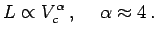 times higher than the mean!
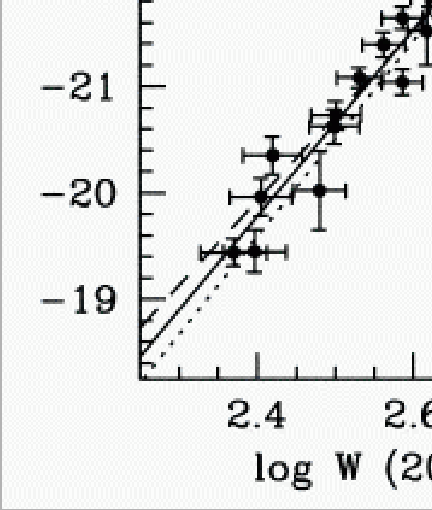 |
And so we're done: the Deuterium abundance determines the gas density
through the known nuclear reactions that occurred during Big Bang
nucleo-synthesis. And the dark matter density is
 with
with
 determined from
clusters.
determined from
clusters.