When a system is in equilibrium, forces balance. In a stable equilibrium, small changes remain small, whereas in an unstable equilibrium, small changes are amplified and grow.
For example, consider small perturbations in an infinite,
self-gravitating fluid, with density  and temperature
  . If the
scale
. If the
scale  of the perturbation is small, then you know what
happens: the perturbation will be a sound wave. This is why you can
hear what I am saying. But what happens for perturbations on larger
scales? I'll explain why eventually gravity will become dominant.
of the perturbation is small, then you know what
happens: the perturbation will be a sound wave. This is why you can
hear what I am saying. But what happens for perturbations on larger
scales? I'll explain why eventually gravity will become dominant.
Consider the material inside one perturbation length . The
thermal energy  enclosed within it, is of order
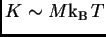 , where
 is the mass within the perturbation (I'm neglecting
constants of order unity, like the
is the mass within the perturbation (I'm neglecting
constants of order unity, like the  and such - we'll do better
later). The gravitational energy
and such - we'll do better
later). The gravitational energy  within the perturbation, is of
order
within the perturbation, is of
order
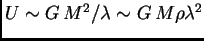 . For sufficiently small
, the gravity energy is small with respect to the thermal
energy, and can be neglected: these are the usual sound waves. But for
larger , the ratio
. For sufficiently small
, the gravity energy is small with respect to the thermal
energy, and can be neglected: these are the usual sound waves. But for
larger , the ratio
 gets bigger, and so
eventually, gravity will dominate! The Jeans mass is the critical mass
above which gravity dominates. For perturbations below the Jeans mass,
pressure forces dominate, and so the perturbation will re-expand when
being compresses. But for perturbation more massive than the Jeans
mass, gravity dominates, and so a perturbation will collapse even
further when compressed, leading to run-away collapse.
gets bigger, and so
eventually, gravity will dominate! The Jeans mass is the critical mass
above which gravity dominates. For perturbations below the Jeans mass,
pressure forces dominate, and so the perturbation will re-expand when
being compresses. But for perturbation more massive than the Jeans
mass, gravity dominates, and so a perturbation will collapse even
further when compressed, leading to run-away collapse.
Now the proper way to derive the criterion where gravity dominates
requires some more mathematics that I don't want to go into. What you
should do, is compute the dispersion relation for sounds waves,
i.e. the relation between the wave-length and the sound speed
 . For small wavelengths, gravity can be neglected, and is
independent of . However, as I explained, for larger and
larger , eventually gravity becomes important and starts
to depend on , and for the critical wave-length
. For small wavelengths, gravity can be neglected, and is
independent of . However, as I explained, for larger and
larger , eventually gravity becomes important and starts
to depend on , and for the critical wave-length  ,
the sound speed becomes zero. Now, gravity dominates, and as the wave
stalls its amplitude will grow, and the perturbation will collapse. I
hope you will have the chance to investigate this nice problem in more
detail somewhere else.
,
the sound speed becomes zero. Now, gravity dominates, and as the wave
stalls its amplitude will grow, and the perturbation will collapse. I
hope you will have the chance to investigate this nice problem in more
detail somewhere else.
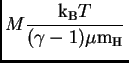
Here we will do a different derivation that follows CO.4.8 Putting in all
the constants, we find that and are given by
Here,
 is Boltzmann's constant,
  the ratio of specific
heats of the gas (e.g.
the ratio of specific
heats of the gas (e.g.
 for a mono-atomic gas), and
  the mean molecular weight (
 for a pure neutral hydrogen gas,
 is the hydrogen is fully ionised). is the product of the
mass of the cloud,
is the hydrogen is fully ionised). is the product of the
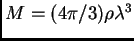
mass of the cloud,  , with the thermal energy per unit mass,
 . The potential energy
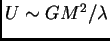 . The factor in front,
  is appropriate for a spherical,
homogeneous density perturbation. Now, in virial equilibrium,
is appropriate for a spherical,
homogeneous density perturbation. Now, in virial equilibrium,  ,
So whenever
,
So whenever  is larger, gravity dominates, and so the critical
length is whenever
is larger, gravity dominates, and so the critical
length is whenever
 in
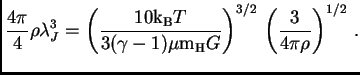
Eqs.(4.5+7.1) to obtain the critical Jeans length
, and the Jeans mass
in
Eqs.(4.5+7.1) to obtain the critical Jeans length
, and the Jeans mass  as
as
 |
 |
 |
(4.7) |
 |
 |
 |
(4.8) |
So note that in a homogeneous fluid, the Jeans mass is the mass
contained in a volume with radius the Jeans length. The latter is such
that perturbations larger than the Jeans length will collapse under
their own gravity.
Fragmentation A nice application of this concept is to
investigate what happens during collapse of a cloud. Let's say that the
Jeans mass is given by
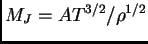 , where I've assembled
all constants into a new constant
, where I've assembled
all constants into a new constant  . Now assume you have a cloud with
mass
. Now assume you have a cloud with
mass  that starts to collapse, and hence increases. In
general will rise as well, and so will change. Now suppose
decreases to
that starts to collapse, and hence increases. In
general will rise as well, and so will change. Now suppose
decreases to  . Following our earlier discussion, this
would mean that, if there were smaller perturbations within the cloud
already (substructure), then those with masses larger than will
start collapsing on their own - the cloud may fragment. Given our
expression for the Jeans mass,
. Following our earlier discussion, this
would mean that, if there were smaller perturbations within the cloud
already (substructure), then those with masses larger than will
start collapsing on their own - the cloud may fragment. Given our
expression for the Jeans mass,  will happen whenever
 increases slower than
 . Let's parametrise the
dependence of on as
. Let's parametrise the
dependence of on as
 . Then requires
 . For adiabatic, mono-atomic gas,
and you don't expect fragmentation. But if radiative
cooling can keep the gas isothermal,
. For adiabatic, mono-atomic gas,
and you don't expect fragmentation. But if radiative
cooling can keep the gas isothermal,  and you expect
fragmentation.
and you expect
fragmentation.
So you've learnt how important cooling is for the formation of stars. After all, the mass of the GMCs in which stars form, is far bigger than stellar masses, and so we need to understand why stars are so much smaller than GMCs.