


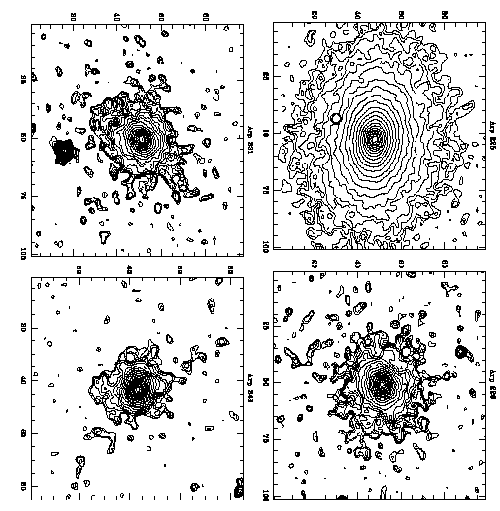
The SB profile of some elliptical are shown in Figure (6.1). Note how in the centre the isophotes are well defined and elliptical, whereas in the outer parts they become less smooth (noisier) because the SB decreases. Also note the presence of fore-ground MW stars.
 |
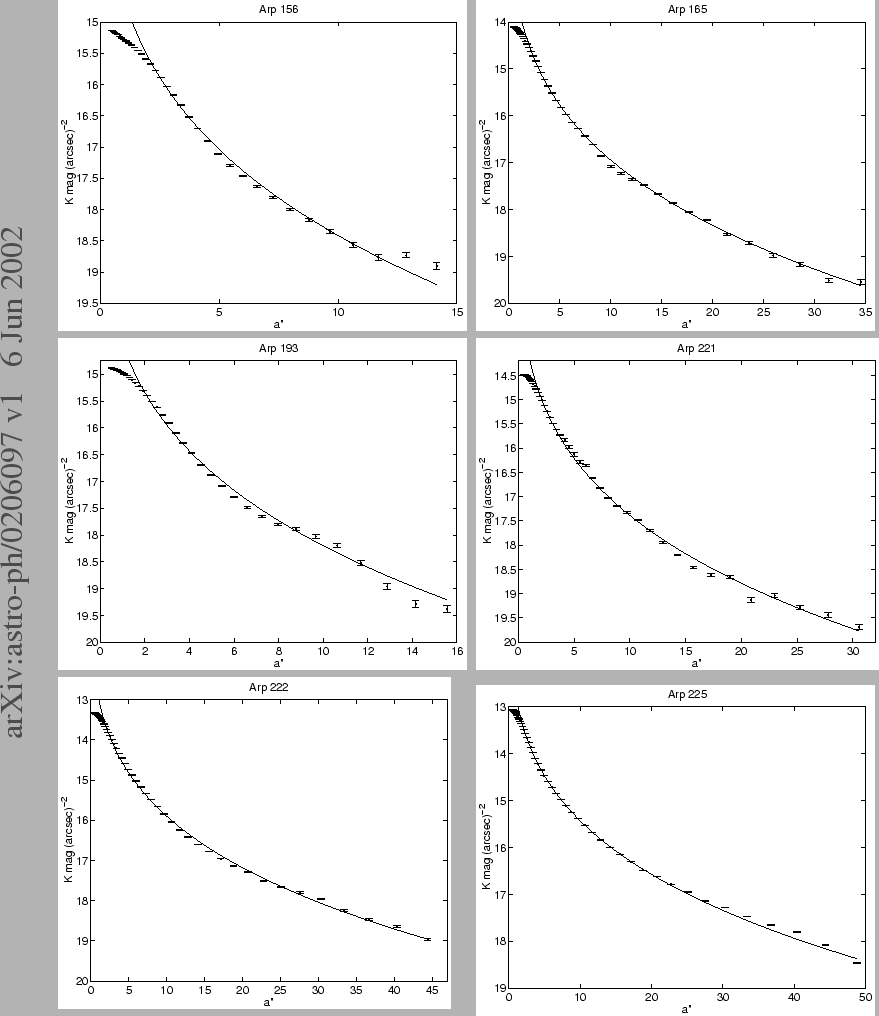
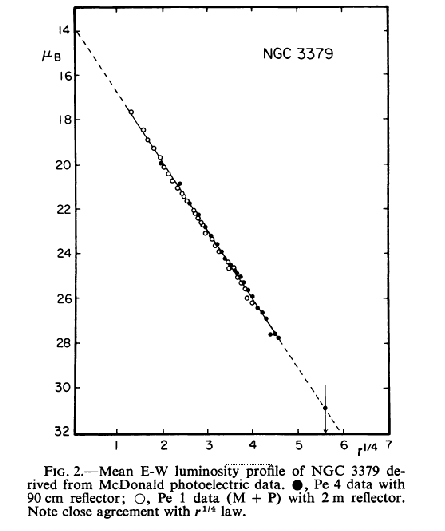
A plot of the average surface brightness as function of radius for
these same ellipticals is shown in Figure (6.2). The drawn
line which fits the data well, is an  fit, Eq. (3.2).
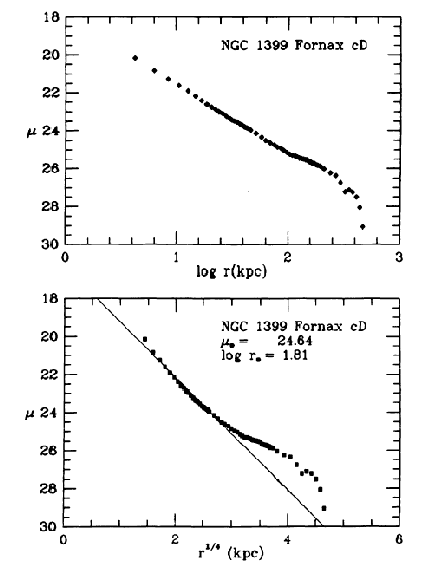
Often, these profiles are plotted as SB vs in which case the
profile is a straight line, as in Figure (6.3). For most
ellipticals this profile shape fits their SB-distribution well,
although some people have suggested to use a more general form,
fit, Eq. (3.2).
Often, these profiles are plotted as SB vs in which case the
profile is a straight line, as in Figure (6.3). For most
ellipticals this profile shape fits their SB-distribution well,
although some people have suggested to use a more general form,
![$ I(r)\propto \exp[-(r/r_e)^{1/n}]$](img351.png) , where
, where  corresponds to the de
Vaucouleurs fit.
corresponds to the de
Vaucouleurs fit.
 truecm
 |
 |
 |
Some of the giant elliptical galaxies that are invariably found in the centres of big clusters of galaxies have an extended halo that is not fit well by the de Vaucouleurs profile. See for example the profile of NGC 1399, which is the cD galaxy in the nearby Fornax cluster of galaxies (Fig. (6.4)). This very extended halo of stars is truly enormous: it can be traced to around a Mpc. Even though the distance to Fornax is large, it means that the extent on the sky of NGC 1399 is about the size of the moon! This gigantic size has prompted the suggestion that may be we should associate such a halo with the cluster of galaxies, rather than with any individual galaxy. This suggestion has some support from the observations of some clusters where we observe a faint halo, but without a galaxy in the centre!
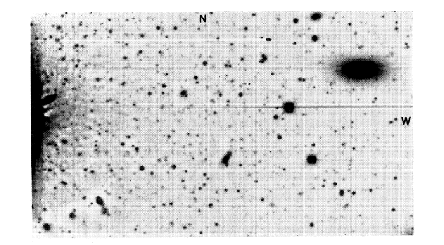
Es also have many globular clusters. Figure (6.5) is an
image of NGC 1399, where an fit to the SB-profile of the
galaxy has been subtracted. Clearly visible are 100s of high SB
objects, indistinguishable on this plate from foreground stars, which
are in fact GCs in the halo of the galaxy. The GC luminosity function
(i.e., the number of clusters as function of their magnitude) has been
used as a standard candle: by measuring the luminosity function of GCs
of a galaxy, and comparing it to the luminosity function of a galaxy
with known distance, one can obtain a distance estimate.
Why do ellipticals have an SB-profile? As I explained
earlier, there seems to be a strong connection between the density of
galaxies (in the sense of how many galaxies you find per Mpc in
a given region, say) and their types: high density regions invariably
contain a much larger fraction of Es than low density regions, where Ss
dominate. So, may be interactions between galaxies have something to do
with it?
in
a given region, say) and their types: high density regions invariably
contain a much larger fraction of Es than low density regions, where Ss
dominate. So, may be interactions between galaxies have something to do
with it?
Recent numerical simulations of collisions between two spiral galaxies
do produce objects with SB-profiles not too different from
appropriate for an E. And although this is a good hint that we're on
the right track, in fact, also in the simulations we don't really know
why this is. In a famous paper, Donald Lynden-Bell suggested that
during a galaxy merger, the gravitational potential  which the
stars feel, changes very rapidly and this might produce a
characteristic density profile6.1. He termed this process violent
relaxation. And so the suggestion is that, as (predominantly spiral)
galaxies fall into galaxy clusters, they will violently interact with
other galaxies, transforming them somehow into Es. And although this
is certainly an important piece of the puzzle, it can't be the whole
story, because the stellar populations of Es and Ss differ.
which the
stars feel, changes very rapidly and this might produce a
characteristic density profile6.1. He termed this process violent
relaxation. And so the suggestion is that, as (predominantly spiral)
galaxies fall into galaxy clusters, they will violently interact with
other galaxies, transforming them somehow into Es. And although this
is certainly an important piece of the puzzle, it can't be the whole
story, because the stellar populations of Es and Ss differ.
 (i.e. a
  )
plot (top panel), meaning the profile is close to a power-law.
)
plot (top panel), meaning the profile is close to a power-law.