


 or O[III]. Combing such an narrow-band image with
images made with others filters gives a false colour image, i.e. the
colour of the object is not how your eye would see it, but the
colour coding has been chosen to bring out a particular feature. Those
really pretty colour pictures of Planetary Nebulae are false colour
images.
or O[III]. Combing such an narrow-band image with
images made with others filters gives a false colour image, i.e. the
colour of the object is not how your eye would see it, but the
colour coding has been chosen to bring out a particular feature. Those
really pretty colour pictures of Planetary Nebulae are false colour
images.
Surface brightness. The brightness of the images depends, apart
from the size and quality of the optics of the camera, the integration
time, and the transparency of the atmosphere (all of which we should be
able to calibrate), on the apparent brightness of the galaxy. So this
is what we want to characterise. Since galaxies are extended, the
brightness varies over the image, and so what we want to measure is the
surface brightness (SB). The SB measures how much light we receive from
the galaxy, per unit solid angle (usually per arcsec ) so it should
have units of flux (e.g. in W), per unit wavelength range, per unit
solid angle on the sky. So for example in units
) so it should
have units of flux (e.g. in W), per unit wavelength range, per unit
solid angle on the sky. So for example in units
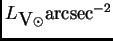 ,
in units of the solar V luminosity. Usually, SB is expressed in
magnitudes, by taking
,
in units of the solar V luminosity. Usually, SB is expressed in
magnitudes, by taking
 of the previous number - we say
(incorrectly, or at least confusingly) that we measure SB in magnitudes
per square arc seconds. (It's confusing, because this suggests we
divide the magnitude by arcsec, but no: we first divide by the solid
angle, and then take the logarithm). As is usual with magnitudes, we
add a constant to it.
of the previous number - we say
(incorrectly, or at least confusingly) that we measure SB in magnitudes
per square arc seconds. (It's confusing, because this suggests we
divide the magnitude by arcsec, but no: we first divide by the solid
angle, and then take the logarithm). As is usual with magnitudes, we
add a constant to it.
The number that characterises the intrinsic brightness
distribution of the galaxy (as opposed to apparent) is how much light
the galaxy emits per unit surface area, so in for example units
of
 . Astronomers do not use separate names for
these two types of SB, so check the units!
. Astronomers do not use separate names for
these two types of SB, so check the units!
Star counts To quantify this a bit more, assume you observe a
distribution of stars, all of the same absolute luminosity  , and
with uniform number density
, and
with uniform number density  (in stars per
  , say). The flux
you receive from a single star, when at distance
, say). The flux
you receive from a single star, when at distance  , is
, is
 (in Wm
 ). The number of stars at distance between and
 , and within a solid angle
  on the sky, is
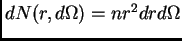 . Combining1.2 these two, the luminosity of all stars within and
, and within , is
. Combining1.2 these two, the luminosity of all stars within and
, and within , is
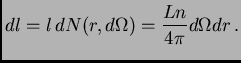 |
(1.1) |
The surface brightness is
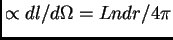 . For an
external galaxy, you could integrate
. For an
external galaxy, you could integrate  along the line of sight
through the galaxy, to get the surface density of stars,
along the line of sight
through the galaxy, to get the surface density of stars,
 of stars. The SB is then
  . The important thing to
notice is that it is independent of the distance . Going back
through the calculation, you can see what has happened: the luminosity
from a single star at distance decreases
. The important thing to
notice is that it is independent of the distance . Going back
through the calculation, you can see what has happened: the luminosity
from a single star at distance decreases
 , but
the number of stars within increases
, but
the number of stars within increases
 . And
since the SB is proportional to the product of these two, it is
independent1.3 of . (You might object
saying we've assumed all stars to have the same luminosity. So just
redo the calculation with the average luminosity then!)
. And
since the SB is proportional to the product of these two, it is
independent1.3 of . (You might object
saying we've assumed all stars to have the same luminosity. So just
redo the calculation with the average luminosity then!)
When looking-out into a stellar distribution - for example when
counting stars in the Milky Way - we should be able to infer  by
counting how many stars we see as function of their luminosity. Here is
how to do it: the number of stars within a solid angle , and
with distance between and ,
, as
we had before. Now again assume them to have all the same intrinsic
luminosity . The trick is to change variables from distance to
apparent magnitude
by
counting how many stars we see as function of their luminosity. Here is
how to do it: the number of stars within a solid angle , and
with distance between and ,
, as
we had before. Now again assume them to have all the same intrinsic
luminosity . The trick is to change variables from distance to
apparent magnitude  , using
 |
(1.2) |
 , the apparent magnitude
 , up to a
constant.1.4
, up to a
constant.1.4  is called the distance modulus.) Now
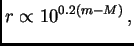
we're almost done, since rearranging
is called the distance modulus.) Now
we're almost done, since rearranging
 |
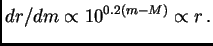 |
Substituting this in the expression for  gives
gives
 |
(1.3) |
For example, if the number density is constant (and hence also  is constant), then,
 . In other words: by going one magnitude fainter, we get around 4
times as many stars. If we get fewer, then either the more distant stars
are intrinsically fainter, or light has been lost on the way, or the
density of stars drops (or some combination).
. In other words: by going one magnitude fainter, we get around 4
times as many stars. If we get fewer, then either the more distant stars
are intrinsically fainter, or light has been lost on the way, or the
density of stars drops (or some combination).
As a last exercise: we found that the luminosity of all stars in a shell, within a given solid angle, was independent of the radius of the shell. So, integrating over all radii, we get an infinite luminosity. Which clearly conflicts with the fact that the night sky is dark. This is called Olber's paradox. What is wrong with this reasoning?