


Next: Galaxy scaling relations
Up: Galaxy statistics
Previous: Galaxy statistics
Contents
In the previous chapter we saw how some galaxies are in low density
environments, some are in higher density groups, and others in dense
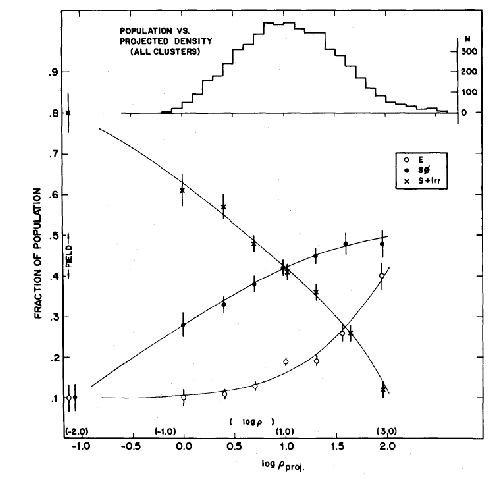
clusters of many hundred galaxies. Figure 10.1 shows that
the fraction of elliptical and S0 galaxies increases rapidly with
increasing galaxy density. In other words, in a region of high galaxy
density, such as a dense group or cluster of galaxies, most galaxies
tend to be S0 or E, and very few are of type S. Vice versa, in regions
of low galaxy density, most galaxies tend to be of the type S. This is
called the density-morphology relation, since it relates the
density of galaxies in a given region with their typical morphology
(i.e. S, E, S0). Clearly this is telling us something on the nature of
galaxy formation and evolution.
Recall from the movie I showed of the motion of galaxies in a cluster,
that encounters between galaxies are very frequent in a region of high
galaxy density. Such tidal encounters could be responsible for
converting S-type galaxies into S0 and E, but other processes might
operate as well. Recall that we already discussed that this cannot be
the whole story, since the stellar populations of Ss and Es tend to
differ as well.
Figure 10.1:
The fraction of Elliptical (E), S0, and Spiral + Irregular
(S+I) galaxies as function of the logarithm of the projected density,
in galaxies Mpc . The data shown are for all cluster galaxies in
the sample and for the field. Also shown is an estimated scale of true
space density in galaxies Mpc
. The data shown are for all cluster galaxies in
the sample and for the field. Also shown is an estimated scale of true
space density in galaxies Mpc . The upper histogram show the
number distribution of the galaxies over the bins of projected
density. Es and S0s tend to populated regions of high galaxy density,
and Ss regoins of low galaxy density. From Dressler, ApJ 236, p. 351
(1980).
. The upper histogram show the
number distribution of the galaxies over the bins of projected
density. Es and S0s tend to populated regions of high galaxy density,
and Ss regoins of low galaxy density. From Dressler, ApJ 236, p. 351
(1980).
 |
Next: Galaxy scaling relations
Up: Galaxy statistics
Previous: Galaxy statistics
Contents
Tom Theuns
2003-04-28