of the stars in an E-type galaxy with the total
luminosity
of the stars in an E-type galaxy with the total
luminosity  ,
,
Compare with the Tully-Fisher relation for spirals, eq. (10.1):
the velocity dispersion takes the role of the circular
velocity  .
.
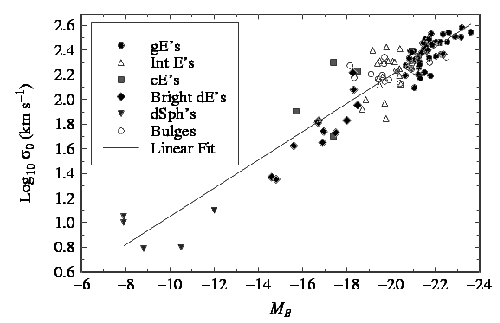
Comparison of Figure 10.3 with Figure 10.2 shows that
the scatter in the Faber-Jackson relation is quite a bit bigger
than the scatter in the Tully-Fisher relation: at a given value of
, there is a range of  magnitudes in
  (i.e. a
factor 2.5 in ) for a given value of , versus a few tenths
of a magnitude for a given value of in the Tully-Fisher
relation. So ellipticals follow a similar relation as spirals, with
more luminous and hence more massive, ellipticals having a large
velocity dispersion, but the relation is not very tight.
(i.e. a
factor 2.5 in ) for a given value of , versus a few tenths
of a magnitude for a given value of in the Tully-Fisher
relation. So ellipticals follow a similar relation as spirals, with
more luminous and hence more massive, ellipticals having a large
velocity dispersion, but the relation is not very tight.
 |
From all the parameters we can measure for an elliptical, the total
luminosity , the velocity dispersion , the effective radius
 and the surface brightness
  (which both enter in the de
Vaucouleurs profile, Eq. (3.2)), only three are independent. So
we can try to obtain a tighter relation by introducing a second
parameter in Eq. (10.7), for example . If the galaxy is in
virial equilibrium, then its kinetic energy
(which both enter in the de
Vaucouleurs profile, Eq. (3.2)), only three are independent. So
we can try to obtain a tighter relation by introducing a second
parameter in Eq. (10.7), for example . If the galaxy is in
virial equilibrium, then its kinetic energy
 will be
proportional to its potential energy
will be
proportional to its potential energy  , and so we expect
 |
(10.8) |
Introducing again the mass-to-light ratio, [M/L] this can be written as
![$\displaystyle \sigma^2 \propto \hbox{[M/L]}{L\over R_e} \propto {L^{1+\alpha}\over R_e} ,$](img639.png) |
(10.9) |
where I've assume [M/L] to depend on as
 , hence
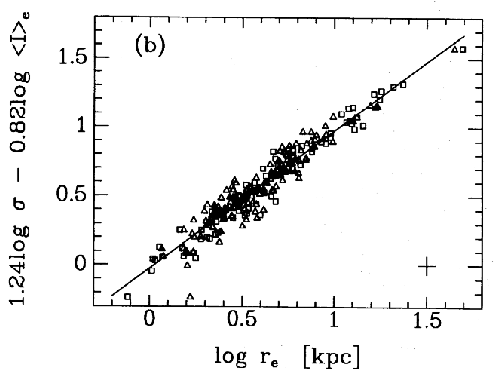 |
Figure 10.4 shows that
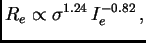
for the same sample of ellipticals plotted in Figure 10.3. The
galaxies follow this relation with very little scatter. Comparing the
last two equations shows that if we assume
 , then
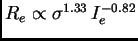 - very nearly the same to what
the figure suggests. Put differently, if the mass-to-light ratio of
ellipticals depends on luminosity as
- very nearly the same to what
the figure suggests. Put differently, if the mass-to-light ratio of
ellipticals depends on luminosity as
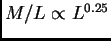 , then we can
understand why ellipticals follow the relation plotted in
Figure 10.4 so tightly.
, then we can
understand why ellipticals follow the relation plotted in
Figure 10.4 so tightly.
The relation Eq. (10.12) is called the fundamental plane
of elliptical galaxies. In four dimensional , , and
space, galaxies do not occupy the whole space, but are restricted
to a 3-dimensional surface defined by relation (10.12).

 for a sample of elliptical
galaxies plotted versus the velocity dispersion
for a sample of elliptical
galaxies plotted versus the velocity dispersion  ). Brighter ellipticals galaxies (more negative
  ;
recall that magnitude
;
recall that magnitude 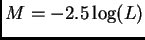 +constant) have a larger velocity dispersion.
![$\displaystyle \hbox{[M/L]}\propto L^\alpha .$](img640.png)

 for the
same sample of Es plotted in Figure
for the
same sample of Es plotted in Figure