. The amount of light
of this ray absorbed per unit distance, will satisfy
. The amount of light
of this ray absorbed per unit distance, will satisfy
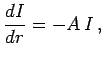 |
(2.3) |
 will absorb a constant
fraction
will absorb a constant
fraction
 of the light. This is what we want since,
if the light source were twice as bright, then the bricks will stop
twice as many photons.
of the light. This is what we want since,
if the light source were twice as bright, then the bricks will stop
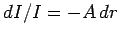
twice as many photons.  is some constant, which will depend on the
size of the bricks, and their number density. This equation is easy to
integrate, and the solution is
is some constant, which will depend on the
size of the bricks, and their number density. This equation is easy to
integrate, and the solution is
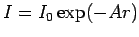 . Taking the
  of
both sides, we find that the effect on the magnitude will be
of
both sides, we find that the effect on the magnitude will be
 .
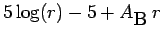
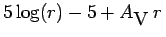
So the relation between apparent (
.
So the relation between apparent ( ) and absolute magnitude (
 ) will
change from
) will
change from
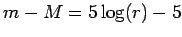 to
is magnitudes per
kpc. (Careful readers will notice that I have slightly changed the
definition of along the way, but you get the idea.)
to
is magnitudes per
kpc. (Careful readers will notice that I have slightly changed the
definition of along the way, but you get the idea.)
If the size of the particles is of order of the wavelength  of
the light, then it is not a good approximation to use the geometric
cross-section of the dust grains to estimate absorption. The amount of
absorption (the value of ) will then depend on , and so
of
the light, then it is not a good approximation to use the geometric
cross-section of the dust grains to estimate absorption. The amount of
absorption (the value of ) will then depend on , and so
 , say: absorption in the B band will differ from that
in the V band, and so absorption will also lead to a colour change
(reddening, since the longer wavelengths get less absorbed than
the shorter ones).
, say: absorption in the B band will differ from that
in the V band, and so absorption will also lead to a colour change
(reddening, since the longer wavelengths get less absorbed than
the shorter ones).
Applying Eq.(2.4) to two bands, we find
 is called the colour excess, note that it is
the difference between the observed and intrinsic colour of the star,
is called the colour excess, note that it is
the difference between the observed and intrinsic colour of the star,
 |
(2.6) |
Trumpler's measurements, and also laboratory measurements, show that for interstellar dust grains
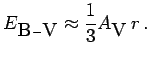 |
(2.7) |
This is a crucial result. Reddening and hence
, is easy to
measure, and so if we do this for stars of known distance, we
find2.3
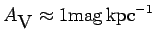 . If we now measure
for another star
of known colour (from stellar evolutionary models say) we can
estimate
. If we now measure
for another star
of known colour (from stellar evolutionary models say) we can
estimate  .
.