


The Tully-Fisher relation Eq. (10.1) relates the luminosity  of a galaxy to its circular velocity. Now suppose we were able to
measure the proportionality constant, by determining the luminosity for
galaxies with known distance. Then by just measuring the circular
velocity of a spiral galaxy, we could infer its luminosity hence
absolute magnitude
of a galaxy to its circular velocity. Now suppose we were able to
measure the proportionality constant, by determining the luminosity for
galaxies with known distance. Then by just measuring the circular
velocity of a spiral galaxy, we could infer its luminosity hence
absolute magnitude  , and consequently from its apparent magnitude
 obtain the distance
  , since
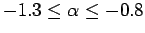 |
(10.13) |
Therefore, the Tully-Fisher relation can be used as a standard candle,
since it allows us to determine the luminosity from the distance
independent quantity  . Note also that is relatively easy to
determine from spectra, and so we have found a good way of measuring
distances to distant galaxies!
. Note also that is relatively easy to
determine from spectra, and so we have found a good way of measuring
distances to distant galaxies!
The fundamental plane relation plotted in Figure 10.4 can also
be used as a standard candle: all we need to do is measure the velocity
dispersion of the stars  from a spectrum, and determine the
intensity
from a spectrum, and determine the
intensity 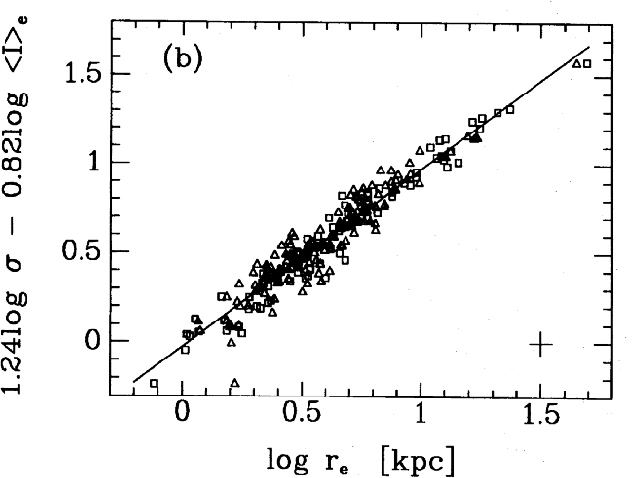 (recall that the surface brightness and hence also
is distance independent). By putting the E galaxy onto
Figure 10.4, we then find
(recall that the surface brightness and hence also
is distance independent). By putting the E galaxy onto
Figure 10.4, we then find  . And so from the apparent size
of the galaxy, we can estimate its distance.
. And so from the apparent size
of the galaxy, we can estimate its distance.
Both these methods are widely used, since measuring velocities is relatively easy from a good quality spectrum, and can be done even for faint and/or distant galaxies. And since the scatter in the relations is small, we can obtain a relatively accurate distance estimate.