


 and
and 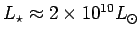 ,
where is either the total (or bolometric) luminosity, or the
luminosity in some band, e.g. the B-band, per unit
volume. Figure 10.5 shows that the number of faint galaxies
increases like a power law, whereas there is an abrupt cut-off toward
the brighter galaxies. This behaviour is well captured by the Schechter function
,
where is either the total (or bolometric) luminosity, or the
luminosity in some band, e.g. the B-band, per unit
volume. Figure 10.5 shows that the number of faint galaxies
increases like a power law, whereas there is an abrupt cut-off toward
the brighter galaxies. This behaviour is well captured by the Schechter function
 |
(10.14) |
This function has three parameters,  ,
,
 and
and
 . For luminous galaxies, it has an exponential cut-off for
galaxies brighter than . For less luminous galaxies, the
number increases toward fainter galaxies, as
. For luminous galaxies, it has an exponential cut-off for
galaxies brighter than . For less luminous galaxies, the
number increases toward fainter galaxies, as
 . Finally, is a normalisation constant, which determines
the mean number density of galaxies.
. Finally, is a normalisation constant, which determines
the mean number density of galaxies.
Values are
 Mpc
Mpc , the steepness of the
faint-end slope
, the steepness of the
faint-end slope
 , and the exponential cut-off
sets in at
, and the exponential cut-off
sets in at
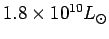
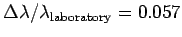 in the B-band. From
Table 3.1, we find that the total B-band luminosity of the MW
is about
in the B-band. From
Table 3.1, we find that the total B-band luminosity of the MW
is about
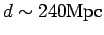 , so the MW is just slightly fainter
than an galaxy.
, so the MW is just slightly fainter
than an galaxy.
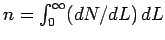
If the faint-end slope is steeper than 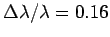 , then the total
number of galaxies per unit volume,
, then the total
number of galaxies per unit volume,
 diverges, because there are so many faint galaxies. In reality, this
does not happen of course, since there must be some finite number of
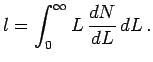
small galaxies. The mean luminosity density can be found from integrating
diverges, because there are so many faint galaxies. In reality, this
does not happen of course, since there must be some finite number of
small galaxies. The mean luminosity density can be found from integrating
 |
(10.15) |
This is the mean luminosity per unit volume. Combining this with the mean density of the universe as obtained in section 9.4, we can estimate the mass-to-light ratio for the Universe as a whole!
 |
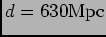
Finally, Figure10.6 shows how the Schechter luminosity function is composed of contributions from the various galaxy types, E, S0 and the different types of spirals, and irregular galaxies. Top panel is for a sample of galaxies away from big clusters, bottom panel refers to the Virgo cluster. Here we recognise the density-morphology once more: most of the brighter galaxies in the top panel are Spirals, whereas in the cluster sample, E an S0s play a much bigger role.
 |
 with
given luminosity
with
given luminosity