


 may vary. Now close enough to the MDO where it dominates
the mass, we should be able to detect the Keplerian rise in velocity
dispersion
may vary. Now close enough to the MDO where it dominates
the mass, we should be able to detect the Keplerian rise in velocity
dispersion
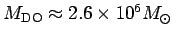 . So people tried to determine
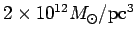 close to the centre.
However again there is a loop hole: can grow as well in
case the velocity distribution becomes anisotropic, e.g. in spherical
coordinates
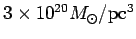 . Again using the
Jeans' equations, the radial variation in mass can be related to the
stellar velocity dispersion as11.11
. Again using the
Jeans' equations, the radial variation in mass can be related to the
stellar velocity dispersion as11.11
 |
 |
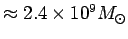 |
|
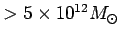 |
![$\displaystyle \left[-{d\ln\nu\sigma^2_r\over
dr}+({\sigma^2_\theta+\sigma^2_\phi\over\sigma^2_r}-2)\right]\,.$](img709.png) |
(11.2) |
 is the circular velocity. Clearly, if we were allowed to choose the three components of
 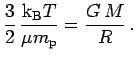 , we could balance a large
increase in density with the velocity tensor becoming more
anisotropic, even in the absence of a MDO.
, we could balance a large
increase in density with the velocity tensor becoming more
anisotropic, even in the absence of a MDO.
Observed galaxies do indeed show a large increase in close to
the centre, but we cannot rule out that this is due to anisotropic
velocities, and not to the presence of a MDO. So once more, the
evidence is a bit circumstantial.